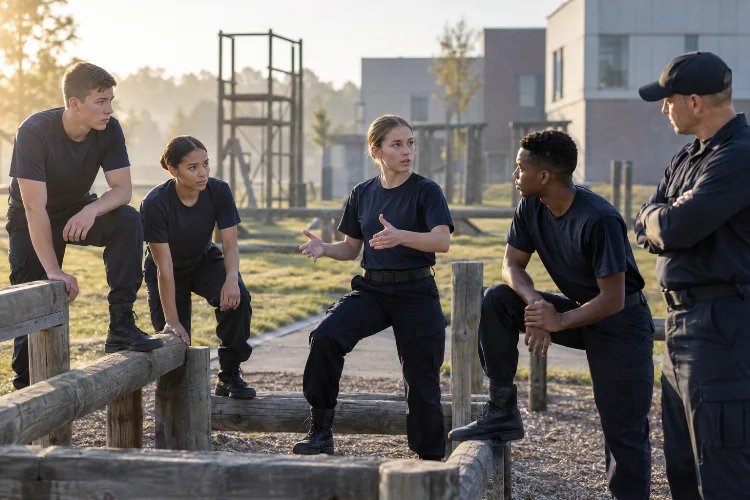
Becoming a police officer involves much more than learning how to patrol streets, investigate crimes, or respond to emergencies.
Officers are trusted with significant authority, which means they must also learn how to make difficult decisions, communicate calmly, follow ethical standards, and take responsibility for their actions.
That preparation often begins long before a new officer works independently.
Understanding how police cadet programmes prepare responsible leaders means looking at the combination of classroom education, physical preparation, scenario-based exercises, field experience, ethics training, and community engagement that can shape future officers.
The exact meaning of a police cadet programme varies between countries and agencies.
Some programmes are formal police academy routes for recruits, while others introduce younger participants to policing careers. However, the broader goal is similar: developing people who can serve professionally and exercise authority responsibly.
Good training does more than teach procedures. It helps future officers build judgment, discipline, integrity, confidence, and a service-oriented approach to leadership.
Cadet Training Builds a Foundation of Professional Knowledge
Before cadets can lead others, they first need to understand the responsibilities of policing.
Training programmes commonly introduce recruits to criminal law, police procedures, investigation, evidence, communication, public safety, and professional standards.
The FBI, for example, says its new-agent training includes academics covering subjects such as ethics, law, behavioral science, investigative techniques, and leadership.
The purpose is not simply to memorize rules.
A cadet needs to understand why a procedure exists and when it applies. Knowing the law behind a search, arrest, interview, or use of authority helps future officers make better decisions when real situations do not match simple textbook examples.
Professional education also creates common standards. When recruits understand what is expected of them, supervisors can more clearly evaluate whether officers are performing their duties safely and lawfully.
That knowledge becomes the foundation for greater responsiblity later in their careers.
Ethics Training Develops Responsible Decision-Making
Police officers regularly face situations where the easiest choice is not always the right one.
A cadet might eventually have to decide how to respond when a colleague behaves improperly, whether certain evidence can legally be used, or how much authority is appropriate in a rapidly changing situation.
That is why ethics needs to be part of police preparation from the beginning.
The FBI has noted that cadets receive ethics training during academy education and that ethical leadership requires standards to be reinforced throughout an officer’s career rather than treated as a one-time lesson.
Modern training can use realistic ethical scenarios rather than simply telling recruits to “do the right thing.” Cadets may be asked to examine competing responsibilities, explain their reasoning, identify legal limits, and consider the consequences of different actions.
This practice helps develop ethical judgment.
Responsible leaders need to understand that reaching a desirable outcome does not justify ignoring proper procedures. Integrity means following professional standards even when doing so is inconvenient.
Scenario-Based Training Strengthens Judgment Under Pressure
Police work is rarely as predictable as a classroom exercise.
An officer may arrive at what appears to be a simple argument and discover that someone is injured. A routine traffic stop can suddenly become a medical emergency. A person who initially seems uncooperative may actually be confused, frightened, or experiencing a crisis.
Scenario-based training helps cadets experience this uncertainty in a controlled environment.
The FBI Academy uses hands-on exercises and realistic scenarios as part of law-enforcement preparation. Its new agents combine classroom learning with case exercises and operational training designed to reflect situations they may encounter later.
The goal is not to predict every situation an officer will face.
Instead, cadets learn to observe carefully, gather information, control their reactions, evaluate risk, and make a reasonable descision based on the facts available.
After an exercise, instructors can review what happened. Cadets can discuss what they noticed, what they missed, and how they might respond differently next time.
This reflection is an important leadership habit. Good leaders do not simply act; they also examine their actions and learn from them.
Communication Training Teaches Cadets to Lead Without Relying on Authority
Police leadership is not always about giving orders.
Much of an officer’s day may involve explaining rules, listening to residents, calming arguments, interviewing witnesses, speaking with victims, coordinating with colleagues, or helping confused members of the public understand what happens next.
Strong communication can sometimes prevent a difficult situation from becoming more serious.
Cadet programmes therefore have an opportunity to teach active listening, clear instructions, respectful language, interviewing techniques, conflict management, and de-escalation.
Modern academy initiatives increasingly emphasize crisis response and de-escalation as skills that should be integrated throughout recruit education rather than isolated in a single training session.
The U.S. COPS Office has supported academy curriculum work focused specifically on these concepts.
This matters for leadership because people are more likely to cooperate when they understand what is happening and believe they are being treated respectfully.
A future officer who can communicate calmly often has more options available than one who relies immediately on authority.
Discipline Teaches Accountability and Self-Control
Police cadet training is often structured and demanding for a reason.
Recruits may have schedules to follow, physical standards to maintain, assignments to complete, equipment to manage, and professional expectations to meet. These requirements can help build habits of preparation and self-discipline.
The FBI notes that completing the process of becoming an officer requires traits such as motivation, initiative, and perseverance.
Discipline in policing should not simply mean obeying instructions without thinking.
Responsible discipline also means arriving prepared, controlling emotional reactions, following lawful procedures, completing reports accurately, accepting feedback, and remaining dependable when situations become stressful.
These everyday habits matter because police organizations depend heavily on trust between colleagues.
An officer who fails to complete an important task can create additional risks for another officer, a victim, a suspect, or the wider communty.
Leadership therefore begins with learning to manage one’s own behavior before expecting to manage other people.
Community Engagement Builds a Service-Oriented Mindset
Cadets also need to understand that policing is fundamentally a public-service profession.
A person can become technically skilled at law enforcement while still struggling to understand the community they serve. That is why community interaction can be an important part of police education.
Community-oriented policing encourages officers to build relationships, understand local concerns, and work with residents and organizations to solve recurring problems rather than responding only after incidents occur.
The U.S. COPS Office has developed post-academy training approaches that combine community policing, problem solving, and practical field learning for new officers.
Community engagement can expose cadets to perspectives they may not encounter inside an academy.
They might meet business owners concerned about theft, young people worried about neighborhood safety, residents frustrated by traffic problems, or social-service professionals working with vulnerable populations.
Those experiences remind future officers that good policing is not simply about enforcing rules.
It is also about understanding people.
Field Training Turns Classroom Lessons Into Professional Habits
Graduating from an academy does not mean that learning is finished.
New officers often continue developing through supervised field experience. This stage can be especially important because recruits finally have to apply legal knowledge, communication skills, ethical principles, and tactical training in real situations.
Research from the College of Policing has highlighted how both formal learning and frontline experience influence the decision-making of newly recruited officers.
A good field supervisor does more than show a recruit how tasks are completed.
The supervisor can ask why the trainee chose a particular approach, explain alternatives, correct mistakes, demonstrate professional behavior, and encourage reflection.
This is where organizational culture becomes extremely important.
If new officers repeatedly see experienced personnel ignoring the values taught during academy training, those lessons may weaken.
Research on ethical decision-making has similarly suggested that experienced colleagues and workplace culture can become powerful influences on newer officers.
For that reason, leadership development cannot stop at graduation.
Cadet Programmes Introduce Leadership Before Rank or Promotion
People sometimes assume leadership begins when an officer becomes a supervisor.
In reality, leadership can start on the first day of service.
A junior officer may need to take initiative at an accident scene, reassure a frightened victim, speak up when something is wrong, help a colleague, or make a lawful decision without waiting for detailed instructions.
Police leadership programmes increasingly recognize that leadership skills should exist throughout an organization.
The College of Policing, for example, provides leadership development that begins with new recruits and later expands into topics such as operational leadership, community relationships, and multi-agency cooperation.
This approach changes the idea of leadership.
Leadership is not merely having authority over other officers. It includes judgment, integrity, communication, accountability, courage, and the ability to influence situations positively.
Cadets who learn these principles early are better prepared to accept greater duties later.
Over time, that foundation can support the development of more profesional supervisors, investigators, trainers, commanders, and community leaders.
Police cadet programmes play an important role in preparing future officers for responsibilities that go far beyond enforcing laws.
Effective training combines legal knowledge, ethics, practical scenarios, communication, discipline, community engagement, and supervised experience.
Most importantly, cadet education can teach future officers that leadership begins before anyone receives a formal leadership title.
It begins with making responsible decisions, treating people fairly, controlling personal behavior, accepting accountability, and continuing to learn from experience.
Strong police organizations need officers who are both capable and trustworthy. Building those qualities early can help create professionals who are prepared to serve their communities responsibly.
If you are considering a policing career, explore the curriculum, ethical standards, field-training process, and leadership development offered by the police academy or cadet programme in your area.