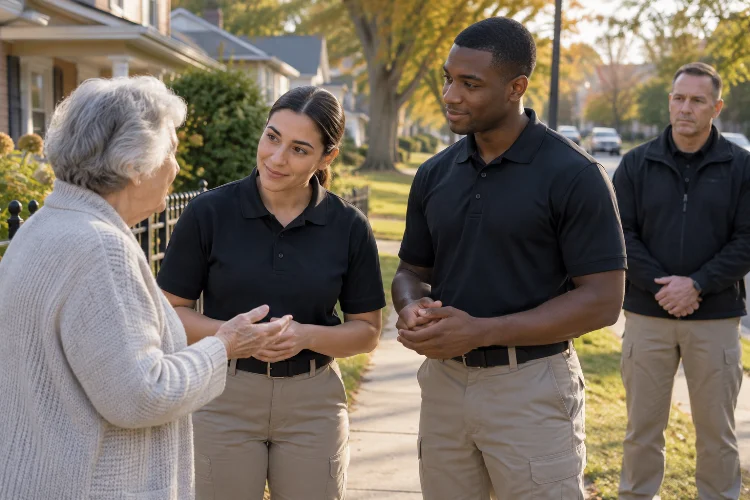
You can learn a lot about policing in a classroom. Cadets can study laws, communication techniques, ethics, report writing, public safety, and the procedures officers are expected to follow.
But knowing what a textbook says is very different from standing in front of a real person who is confused, upset, frightened, or asking for help.
That gap explains why police cadet training combines learning and service. Classroom education gives future officers knowledge and principles, while practical experience helps them understand how those ideas work around real people and real communities.
The exact structure of a cadet programme varies between police organizations.
Some programmes prepare recruits directly for policing careers, while others allow college students or younger participants to explore law enforcement through training, employment, or community activities.
For example, the NYPD Cadet Corps combines college study with monthly Police Academy training and work experience. Whatever the format, combining education with service can turn abstract lessons into useful professional habits.
Classroom Learning Gives Cadets the Foundation
Before someone can apply police procedures responsibly, they need to understand them.
Academic training can cover criminal law, investigation, ethics, behavioral science, communication, evidence, report writing, leadership, and other subjects relevant to public safety.
The FBI Academy provides a useful example of this balance. New agents complete extensive training that includes academics, case exercises, operational skills, investigative techniques, law, ethics, behavioral science, and leadership.
Learning these subjects in a controlled environment gives trainees time to ask questions and understand why particular rules exist.
Consider something as basic as interviewing a witness. A cadet can first learn how to ask clear questions, avoid unnecessarily influencing someone’s answers, document information, and communicate respectfully.
Those principles create a foundation. Practical experiance then shows why they matter when the person being interviewed is nervous, distracted, emotional, or struggling to remember details.
Practical Service Turns Knowledge Into Skills
Reading about communication and actually communicating with the public are two very different things.
Practical service gives cadets opportunities to apply what they have learned.
Depending on the programme and legal limits placed on cadets, this might include administrative work, community events, supervised public-safety activities, observational assignments, or other support roles.
The purpose is not to give inexperienced trainees responsibilities they are not ready to handle. It is to introduce them gradually to the environment in which policing takes place.
This connection between learning and application is also important after formal academy education.
The U.S. Department of Justice’s Police Training Officer model was specifically designed to help new officers apply policing and problem-solving skills during post-academy field training.
A cadet may understand community policing intellectually after a lesson. Working around residents can reveal something deeper: public safety problems rarely arrive as neat textbook exercises.
Real situations require listening, interpretation, patience, and judgment.
Community Contact Teaches Cadets Who They Serve
Police organizations exist to serve communities, so it makes sense that training should involve more than spending time inside an academy.
Direct community exposure can help cadets understand the variety of people they may eventually encounter.
A business owner might be worried about repeated theft. Parents may be concerned about traffic near a school. Older residents might want safer public spaces, while teenagers may have completely different concerns about their neighborhood.
These conversations provide context that a lecture cannot fully reproduce.
Modern thinking about police recruit training increasingly emphasizes community partnership, collaboration, communication, and problem solving alongside traditional enforcement skills.
The U.S. COPS Office has noted that officers today are expected to function as community partners and creative problem solvers, not simply law enforcers.
Service experience can therefore help cadets develop a simple but important habit: listening before assuming they understand the problem.
That habit becomes part of responsible policing later.
Real Situations Develop Better Problem-Solving Skills
Textbook problems usually give you all the information you need.
Real life does not.
Imagine a cadet learning about repeated disorder around a public park. The obvious response might initially seem to be increased enforcement. But conversations with residents could reveal poor lighting, damaged facilities, limited youth activities, or confusion about who manages the area.
Suddenly, the problem becomes more complicated.
Problem-based police training is designed around this reality. In the COPS Office’s Police Training Officer model, recruits work through problems with partners who may include police personnel, social or community services, victims, witnesses, and other members of the public.
This teaches cadets to look beyond the first obvious answer.
Good police work often requires identifying what is actually causing a recurring problem, considering several options, and deciding which response is lawful, proportionate, and realistic.
That kind of pratical judgment grows through experience.
Service Helps Build Communication and Emotional Control
Police officers meet people on some of the best and worst days of their lives.
Someone may be angry after a traffic collision, frightened after becoming a victim of crime, impatient during a public event, or simply confused about what an officer is asking them to do.
For that reason, communication cannot be treated as a minor “soft skill.”
Cadet service provides opportunities to practise explaining information clearly, listening without immediately interrupting, remaining respectful during disagreement, and adjusting communication for different audiences.
These experiences can also teach emotional control.
Being professional when everyone around you is calm is relatively easy. Remaining professional when someone is frustrated or disrespectful takes more discipline.
Modern recruit-training guidance recognizes this challenge. The COPS Office has highlighted communication, de-escalation, crisis intervention, collaboration, and strategic thinking as important abilities alongside technical police skills.
Cadets who develop these habits early may be better prepared to handle stressful encounters without allowing emotion to control their decisions.
Learning and Service Reinforce Ethics
Ethics can sound straightforward when discussed in a classroom.
Follow the law. Treat people fairly. Use authority responsibly. Tell the truth.
The difficulty begins when those principles meet complicated circumstances.
Service exposes cadets to situations where professional values need to guide actual behavior. They may encounter confidential information, see someone make a mistake, receive criticism from a member of the public, or face pressure to complete a task quickly.
These experiences make ethical education more concrete.
Instead of asking only, “What does the policy say?” cadets begin asking, “What should I do when following that principle becomes inconvenient?”
That question matters because police authority comes with responsiblity.
United Nations guidance on police capacity-building similarly emphasizes that professional development involves more than individual technical instruction.
Training, mentoring, monitoring, accountability, and institutional development all contribute to stronger policing.
Learning ethical principles and then seeing how they operate in service can help those principles become professional habits rather than exam answers.
Mentoring Connects Theory With Reality
One of the most valuable parts of practical training is having someone experienced nearby.
A mentor or field trainer can help a cadet understand why a situation unfolded differently from what they expected.
Research published by the College of Policing found that student officers valued mentoring alongside formal education. Participants described mentors as helping them connect the different pieces of classroom learning with the realities of police work.
Good mentoring involves more than telling cadets what to do.
After an activity, a supervisor might ask: What did you notice? Why did you choose that response? What alternatives were available? How did the person react? What would you change next time?
Those questions encourage reflection rather than simple imitation.
This matters because future officers cannot depend on a supervisor to make every decision for them. Eventually, they need enough knowledge and judgment to think independently while remaining within legal and professional standards.
Combining Education and Service Builds Professional Identity
Cadet training is also about discovering what being a police professional actually means.
At first, trainees may focus heavily on uniforms, procedures, ranks, equipment, or operational skills. Those things are visible and easy to associate with policing.
Service gradually adds another dimension.
Cadets begin to see that police work often involves helping someone understand a process, coordinating with another organization, solving a small neighborhood problem, completing accurate documentation, or simply being dependable.
In the NYPD Cadet Corps, for example, participating college students combine their academic education with regular academy training and paid work within the organization.
The exact model is not universal, but the principle is useful.
Education explains the standards of the profession. Service demonstrates what those standards look like when other people depend on you.
Together, they can help build communcation, discipline, empathy, judgment, teamwork, and a stronger sense of public responsibility.
Police cadet development works best when learning does not remain trapped inside a classroom.
Academic education gives trainees essential knowledge about law, ethics, communication, investigation, and professional standards, while supervised service helps them understand how those lessons operate in everyday situations.
Combining the two can strengthen problem-solving, emotional control, community awareness, teamwork, and responsible decision-making. It also reminds future officers that policing is ultimately a public-service profession.
A strong cadet programme should therefore teach not only what officers need to know, but how that knowledge should be used around real people.
If you are considering a policing career, explore how your local cadet or recruit programme balances classroom education, practical experience, mentoring, community engagement, and ethical development before choosing your path.