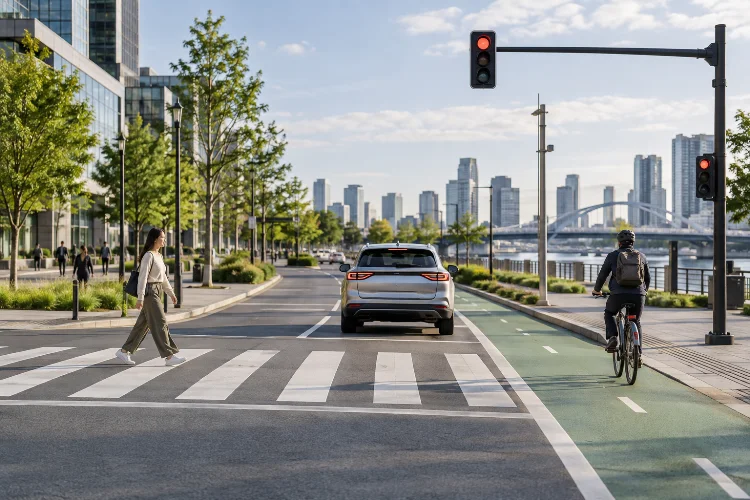
Imagine a busy intersection where every driver chooses their own speed, cyclists ignore signals, and pedestrians cross whenever they feel like it. Even if everyone is paying attention, predicting what happens next would be almost impossible.
That is the basic reason traffic rules exist.
Understanding why traffic rules matter for drivers, cyclists, and walkers is not simply about memorizing signs or avoiding a fine.
Road rules create a shared system that helps people predict each other’s movements, manage speed, decide who has priority, and reduce dangerous conflicts.
The stakes are significant. The World Health Organization estimates that approximately 1.16 million people die in road traffic crashes globally each year, while another 20-50 million experience non-fatal injuries.
More than half of road deaths involve vulnerable road users such as pedestrians, cyclists, and motorcyclists.
Traffic laws cannot prevent every mistake. However, when road users understand and follow clear rules, everyday movement becomes far more predictable – and safer.
Traffic Rules Make Road Behavior Predictable
A road system works partly because people have some idea of what others are supposed to do.
Drivers know that a red signal generally means stop. Cyclists understand that road signs and directional rules apply to their movement where local law requires it. Pedestrians use designated crossings and signals to identify safer opportunities to cross.
Without this shared framework, every intersection would become a negotiation.
Predictability is especially important because road users make decisions in seconds. A driver approaching a junction may check for pedestrians, cyclists, turning vehicles, traffic signals, and approaching traffic almost simultaneously.
Rules reduce some of that uncertainty.
When everyone follows the expected pattern, another person’s behavior becomes easier to anticipate. This gives people more time to react and helps prevent conflicts from developing in the first place.
Specific traffic laws differ between countries and cities, so everyone should learn the official rules where they live or travel. The general principle, however, is universal: predictable movement creates safer roads.
Speed Rules Matter Because Crash Severity Changes Quickly
Speed limits can sometimes feel arbitrary, especially when a road appears empty.
But speed affects much more than how quickly you reach your destination. It influences stopping distance, reaction time, the likelihood of a collision, and how serious the injuries may be if a crash occurs.
WHO reports that every 1% increase in mean speed is associated with roughly a 4% increase in fatal crash risk and a 3% increase in serious crash risk. It also notes that the risk of pedestrian death rises rapidly as vehicle impact speed increases.
This matters because people outside vehicles have little physical protection.
If a driver notices a pedestrian late, even a small reduction in vehicle speed can provide additional time to brake or steer safely.
For cyclists, lower traffic speeds can also reduce both crash likelihood and injury severity. CDC guidance notes that lower speed limits can increase reaction time for drivers and cyclists, resulting in fewer crashes and less severe cycling injuries when collisions occur.
Following speed limits is therefore not just a legal responsiblity. It is one of the simplest ways drivers can reduce the energy involved in a potential crash.
Pedestrians and Cyclists Need Extra Protection
Not every road user faces the same level of risk.
Someone inside a modern car may have a seat belt, airbags, structural protection, and other safety technologies. A pedestrian has none of those things. A cyclist may have a helmet, but their body is still largely exposed during a collision.
This is why pedestrians, cyclists, motorcyclists, and some mobility-device users are often called vulnerable road users.
WHO reports that more than half of global road traffic deaths occur among vulnerable road users. Pedestrians alone represent nearly one-quarter of road crash deaths worldwide.
Road rules can help manage this imbalance.
Requirements to yield, respect crossings, keep safe passing distances, observe bicycle facilities, and reduce speed in pedestrian-heavy areas give more vulnerable people a better chance of traveling safely.
Cyclists and walkers also have responsibilities. Following applicable signals, staying visible, using designated facilities appropriately, and avoiding unpredictable movements can make their intentions clearer to others.
Safety works best when everyone recognizes that the consequences of a mistake are not equal for every road user.
Intersections and Crossings Need Clear Rules
Intersections bring several movement patterns together at once.
Vehicles may travel straight, turn left or right, merge, or stop. Cyclists can approach from another lane while pedestrians cross the same space.
Without clear priority rules, conflicts become almost unavoidable.
Traffic lights, stop signs, marked crossings, turning rules, lane markings, and right-of-way principles organize these movements. They tell people when to move and, just as importantly, when to wait.
The U.S. Department of Transportation has highlighted intersections as important conflict points for vulnerable road users. In U.S. data from 2020, intersections accounted for 27% of all road traffic deaths that year, including pedestrian and bicyclist fatalities.
The exact rules vary by jurisdiction, particularly around cyclist priority and pedestrian crossings. That makes knowing local regulations essential.
A driver should not assume a cyclist will yield when the cyclist legally has priority. Similarly, a pedestrain should understand crossing signals rather than assuming every approaching vehicle can stop instantly.
Rules replace assumptions with clearer expectations.
Visibility and Attention Are Part of Road Safety
Traffic rules only work when people can notice what is happening around them.
A driver looking at a phone may technically know they need to stop at a crossing but fail to see someone entering it. A cyclist without adequate lighting at night may be difficult to detect until a vehicle is dangerously close.
WHO estimates that drivers using mobile phones are approximately four times more likely to be involved in a crash than drivers who are not using one. Phone use can slow reaction time and make maintaining lanes and following distances more difficult.
Visibility matters for people walking and cycling as well.
Road users should follow local requirements concerning bicycle lights, reflectors, road positioning, and other equipment designed to improve visibilty.
Pedestrians can also reduce risk by using appropriate crossing locations and making sure approaching drivers have enough opportunity to see them.
Traffic safety is not about proving who technically had the right of way after a crash.
The better outcome is preventing the collision altogether.
Cyclists Are Part of the Traffic System Too
Cyclists occupy an interesting position in the road environment.
They travel much faster than pedestrians but usually have far less protection than motor-vehicle occupants. Depending on the jurisdiction and type of facility, cyclists may use roads, bicycle lanes, shared paths, or other designated spaces.
That makes clear rules particularly important.
Cyclists need to understand applicable signs, signals, lane-direction rules, yielding requirements, lighting laws, and safe positioning. Drivers, meanwhile, need to recognize bicycles as legitimate road users rather than unexpected obstacles.
CDC estimates that nearly 1,000 bicyclists die annually in U.S. motor-vehicle crashes, with around 120,000 emergency-department visits for cycling injuries each year. Infrastructure such as bicycle lanes, appropriate speed management, and helmet use can help reduce risk.
Good cycling safety is therefore not achieved by placing the entire burden on cyclists.
It requires drivers who watch for bicycles, infrastructure that reduces dangerous conflicts, sensible laws, and cyclists who follow applicable road rules.
Safe Roads Need More Than Individual Good Behavior
Traffic rules are important, but rules alone cannot fix badly designed roads.
Imagine a six-lane road with fast traffic, no sidewalk, poor lighting, and a bus stop on the opposite side. Telling pedestrians to “be careful” does not remove the underlying danger.
This is why modern road safety increasingly uses the Safe System approach.
The approach recognizes that humans will make mistakes and that transportation systems should be designed so those mistakes do not routinely result in death or serious injury.
WHO identifies safe roads, safe speeds, safe vehicles, and safe road users as major elements of this approach.
The Federal Highway Administration similarly emphasizes that pedestrians and bicyclists deserve particular consideration because they are more vulnerable to serious injury when crashes happen.
Practical solutions can include sidewalks, protected cycle lanes, raised crossings, better lighting, traffic-calming measures, clearer markings, and safer intersection design.
Rules and infrastructure should support each other.
A consistant road-safety system makes the safest behavior easier and more intuitive.
Traffic Rules Create Shared Responsibility
Road safety is sometimes discussed as if one group is always responsible for protecting another.
Reality is more complicated.
Drivers have a major responsibility because motor vehicles can cause severe harm, particularly at higher speeds. But cyclists must also ride predictably and obey applicable regulations, while pedestrians need to use roads and crossings with reasonable awareness.
Government agencies have responsibilities too.
Road authorities need to design infrastructure that accounts for different modes of travel. Police and safety agencies need to apply laws fairly. Vehicle manufacturers contribute through safer vehicle design, while communities can identify dangerous streets and advocate for improvements.
The U.S. Department of Transportation describes road safety as a collaborative effort involving infrastructure, planning, enforcement, policy, community groups, and individual road users.
That shared responsibility is important because no single safety measure is perfect.
A pedestrian can make a mistake. A driver can become distracted. A cyclist can misjudge a gap.
A safer transportation system uses rules, design, responsible behavior, and reasonable speeds together so that one mistake does not automatically become a tragedy.
Traffic rules matter because roads are shared spaces where people with very different speeds, vehicles, and levels of physical protection interact every day.
Clear signals, speed limits, right-of-way rules, crossings, bicycle regulations, and safe-driving requirements make those interactions more predictable.
Drivers, cyclists, and walkers all contribute to road safety, but safe behavior must also be supported by thoughtful street design and effective policies. The goal is not simply to avoid tickets. It is to prevent ordinary human mistakes from turning into serious injuries or deaths.
The next time you drive, ride, or walk, pay attention to how many road rules quietly organize your journey. Learn the regulations in your area, stay predictable, respect other road users, and treat every trip as a shared responsibility.