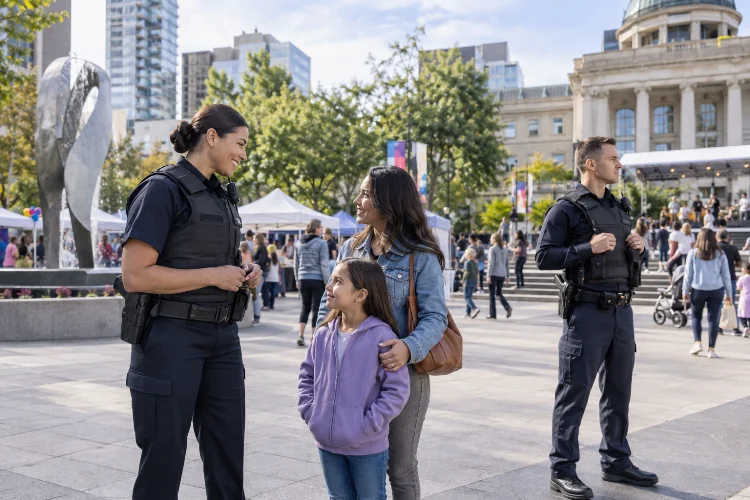
When people think about police services, the first image that often comes to mind is an officer responding to a crime. While responding to criminal activity is certainly an important part of policing, the job is much broader than making arrests.
Police services help communities function safely every day.
Officers may respond to emergencies, investigate crimes, manage traffic incidents, protect major public events, assist vulnerable people, prevent disorder, and work with local residents to identify safety concerns before they become serious problems.
Understanding how police services support safety and public order also means recognizing that effective policing is not simply about enforcement.
Modern police organizations are expected to operate within the law, respect human rights, communicate with the public, and remain accountable for how their authority is used.
In practice, public safety depends on a combination of prevention, rapid response, investigation, cooperation, and community trust.
Police Services Help Prevent and Respond to Crime
One of the most visible responsibilities of police services is preventing and responding to criminal activity.
When a robbery, assault, burglary, or other suspected crime is reported, police officers may secure the scene, protect people from immediate danger, collect information, interview witnesses, identify suspects, and begin an investigation.
However, modern policing increasingly focuses on prevention as well.
Patrols, crime analysis, local intelligence, public awareness campaigns, and partnerships with residents can help police identify patterns before problems become more serious.
According to the U.S. Department of Justice COPS Office, community policing encourages agencies to examine the conditions contributing to public safety problems rather than simply responding after incidents occur.
For example, repeated theft around a transportation hub might not be addressed effectively through arrests alone. Police could also work with transit authorities, businesses, and local government to improve lighting, surveillance, pedestrian flow, or other environmental conditions.
Maintaining Public Order in Shared Spaces
Public order refers to conditions that allow people to use streets, parks, transportation systems, entertainment areas, and other shared spaces safely.
Police may be involved when large crowds gather for sporting events, festivals, demonstrations, concerts, or public celebrations.
The College of Policing describes public order and public safety operations as covering situations such as protests, festivals, sporting events, and disorder where risks to safety or order can reasonably be expected.
The goal is not simply to control crowds. Good public-order policing involves planning, communication, risk assessment, proportionate action, and respect for lawful activities such as peaceful assembly.
Police commanders may coordinate officers, emergency services, transportation agencies, event organizers, and local authorities before a major event takes place. Strong coordinaton can reduce confusion and help authorities respond quickly if conditions change.
Police Officers Provide Emergency Assistance
Police officers are often among the first professionals to arrive when something suddenly goes wrong.
They may respond to traffic crashes, missing-person reports, domestic disturbances, dangerous behavior, natural disasters, suspicious packages, public disturbances, or situations where someone is at immediate risk.
Their first responsibility may not always involve investigating a crime. Officers might instead need to separate people from danger, secure an area, provide basic first aid, manage traffic, evacuate residents, or request firefighters and medical personnel.
The United Nations describes police functions as including the protection of life and property, crime prevention and detection, and maintaining public order and safety within the rule of law.
This emergency responce role makes communication between police, ambulance services, firefighters, hospitals, and disaster-management agencies especially important.
Investigations Help Establish What Happened
Police investigations are another major part of maintaining safety and supporting the justice system.
Investigators may examine physical evidence, security footage, witness statements, financial information, digital records, and other legally obtained material. Their task is to establish facts rather than simply confirm an initial assumption about what happened.
A good investigation can identify suspects, locate victims, uncover connections between incidents, and provide evidence for prosecutors or courts.
Modern investigations can also involve specialized units dealing with cybercrime, financial crime, organized crime, trafficking, missing persons, or crimes against vulnerable individuals.
The process should follow legal rules regarding searches, evidence, interviews, arrests, and individual rights. This matters because public safety and justice depend not only on solving crimes, but on solving them through lawful and reliable procedures.
Community Policing Builds Cooperation and Trust
Police cannot be everywhere at once, which is one reason cooperation with local communties matters.
Community policing encourages officers and residents to work together on recurring safety problems. The OSCE describes community policing as building partnerships of trust between police and the people they serve, with cooperation helping improve safety and quality of life.
The COPS Office similarly identifies partnerships, problem solving, and organizational change as major components of community policing.
Imagine a neighborhood experiencing repeated vandalism around a park. Police could simply respond whenever damage occurs.
A community-based approach would go further by speaking with residents, schools, businesses, youth organizations, and local government to understand why the problem keeps happening.
That conversation might reveal poor lighting, abandoned facilities, limited youth activities, or another underlying issue. Solving those conditions may produce better long-term results than enforcement alone.
Police Services Support Road and Traffic Safety
Traffic policing is another everyday contribution to public order.
Police officers may respond to crashes, manage blocked roads, enforce traffic rules, assist stranded motorists, investigate dangerous driving, and help keep pedestrians and other road users safe.
During major events or emergencies, officers may also redirect traffic so ambulances, firefighters, or evacuation vehicles can reach affected locations.
Traffic enforcement can sometimes seem routine compared with serious criminal investigations, but unsafe roads can have major consequences. Speeding, impaired driving, reckless behavior, and ignored safety rules can put many people at risk.
Effective traffic policing therefore combines enforcement with education, visible presence, incident management, and cooperation with transportation authorities.
Accountability Is Essential for Effective Policing
Police officers are given significant legal authority. Depending on the jurisdiction, that authority may include stopping individuals, making arrests, conducting searches, controlling public spaces, and using force in limited circumstances.
Because those powers directly affect people’s rights, accountability is a fundamental part of professional policing.
The UN Office on Drugs and Crime emphasizes that effective police accountability can involve internal responsibility, independent oversight, complaint procedures, legal accountability, transparency, and external review.
Public confidence is closely connected to whether police institutions are perceived as responsible for their actions.
Accountability does not prevent police from doing their jobs. Done properly, it strengthens legitimate policing.
Clear rules, professional training, supervision, documentation, complaint systems, independent review, and transparent communication can help authorities identify mistakes and improve future practices.
The United Nations also stresses that policing should operate within the rule of law while protecting human rights.
That principle is relevent to nearly every part of police work, from routine patrols to major public-order operations.
Public Safety Requires More Than Police Alone
Police services have an important role, but they cannot create safe communities by themselves.
Many public-safety problems involve housing, education, transportation, mental health services, youth support, healthcare, businesses, local government, and community organizations.
For example, repeated disorder in one location might involve poor urban design, substance misuse, homelessness, lack of lighting, or conflict between local groups. Arresting individuals may sometimes be necessary, but enforcement alone may not address the conditions causing the problem.
This is why problem-oriented and community-based approaches often involve partnerships.
When police share appropriate information and cooperate with other organizations, each agency can contribute its own expertise. The result can be a more complete approach to preventing harm instead of repeatedly responding to the same incidents.
Police services support safety and public order in many ways beyond arresting people who break the law.
Their responsibilities can include crime prevention, emergency response, investigations, traffic safety, public-order management, community engagement, and protection of people and property.
At the same time, effective policing depends on professionalism, accountability, lawful authority, respect for human rights, and public trust.
Police agencies tend to work best when communities see them not only as an enforcement body, but also as a reliable public-safety partner.
Understanding these different roles can help people make more informed judgments about policing in their own communities. Learn how your local police service operates, explore its public-safety programs, and find out how residents can participate in community safety initiatives.