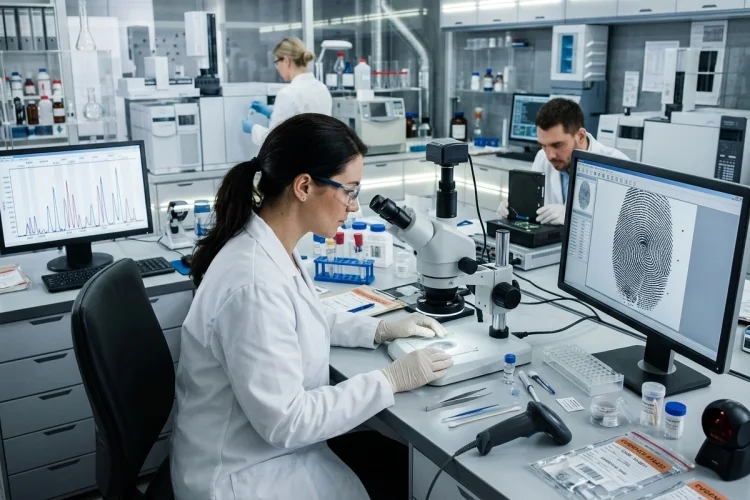
Crime shows often make forensic science look almost magical: a tiny clue enters a laboratory, a computer flashes for a few seconds, and suddenly investigators know exactly who committed the crime.
Real forensic work is much more careful-and much more interesting. Understanding what forensic science contributes to modern investigations starts with recognising its real purpose.
Forensic scientists apply scientific methods to evidence that may help investigators understand an event, identify or exclude people, compare materials, reconstruct aspects of a scene, or provide information that could later be presented in court.
NIST describes forensic science as covering disciplines ranging from DNA and fingerprint examination to drug chemistry and digital evidence.
Modern investigations increasingly combine these scientific findings with witness statements, documents, surveillance footage, and traditional detective work.
Forensic science does not automatically solve a case. Its real strength is helping investigators replace assumptions with evidence that can be tested, compared, documented, and evaluated.
1. Forensic Science Turns Physical Clues Into Useful Information
A crime scene may contain hundreds of objects, but investigators need to determine which ones might actually tell them something.
Physical evidence can include biological material, latent fingerprints, fibres, hair, footprints, tyre impressions, glass fragments, and many other items. NIJ distinguishes this physical evidence from testimonial evidence such as statements made by victims or witnesses.
Forensic science gives investigators methods for examining those materials.
Imagine a burglary where a window has been broken. Investigators might recover glass fragments from the scene and material from a person’s clothing. Laboratory examination could help determine whether those samples share characteristics worth investigating further.
The scientist’s job is not simply to say, “This proves the suspect did it.”
A better question is: What does this evidence scientifically support, and what does it not support?
That distinction keeps forensic conclusions connected to the actual limits of the evidence.
2. DNA Can Link People to Evidence-or Exclude Them
DNA analysis is one of the best-known forensic disciplines.
Biological material such as blood, saliva, skin cells, tissue, or other sources can sometimes provide DNA suitable for forensic examination. Investigators may compare a profile developed from crime-scene evidence with a known sample or search eligible profiles through appropriate databases.
DNA evidence can be valuable because it may associate biological material with an individual.
Just as importantly, it can exclude someone.
NIST notes that forensic science can help exclude innocent people from investigations and has also contributed to exonerations in wrongful-conviction cases.
Context still matters.
Suppose DNA belonging to a particular person is found inside a house. If that person legally lives there, the finding means something very different from finding the same person’s biological material at a location they claim never to have visited.
Forensic results therefore need to be interpreted alongside the circumstances of the case.
3. Fingerprints and Pattern Evidence Help Make Comparisons
Fingerprints have been used in criminal investigations for generations, but they remain part of modern forensic practice.
Fingerprint examiners study friction-ridge detail and may compare latent prints recovered from scenes with known prints. Pattern-related forensic disciplines can also involve footwear impressions, firearm-related marks, toolmarks, and bloodstain patterns.
These comparisons can help investigators narrow possibilities or examine whether evidence is consistent with a particular source.
For example, a latent fingerprint on the exterior of a broken display cabinet might become relevant during a burglary investigation.
But pattern interpretation should not be treated as infallible.
NIJ has highlighted large-scale “black box” studies examining the accuracy and reliability of latent fingerprint examiner decisions.
These studies are important because forensic methods involving human judgment need empirical testing rather than relying solely on professional confidence.
Good forensic science therefore involves both expertise and continuous evaluation of how reliable that expertise actually is.
4. Toxicology Helps Explain Drugs, Alcohol, and Poisons
Not every important clue is visible.
Forensic toxicology examines biological samples for substances such as drugs, alcohol, and other toxins. Toxicology results may help establish what substances were present and whether their concentrations could be relevant to illness, impairment, or death.
Consider an unexplained death.
Investigators might know where the person was found and what witnesses reported, while a toxicologist examines blood or other biological samples. The laboratory findings could reveal substances that help medical and investigative professionals better understand what happened.
Toxicology can also contribute to investigations involving impaired driving, poisoning, drug-related deaths, and other cases where chemical exposure matters.
However, detecting a substance does not always explain its effect automatically.
Dose, timing, tolerance, interactions with other substances, medical history, and other circumstances may all become relevant.
That is another important forensic principle: laboratory numbers need context.
5. Digital Forensics Has Become Part of Everyday Investigation
Modern evidence is increasingly stored in electronics rather than on paper.
NIST defines digital forensics as retrieving, storing, and analysing electronic data that can be useful in criminal investigations. Potential sources include computers, hard drives, mobile phones, and other data-storage devices.
Digital evidence can include messages, photographs, videos, documents, application data, and other electronically stored information. NIST notes that digital material can be relevant to investigations of many different crimes, not simply offences normally labelled “cybercrime.”
Imagine investigating a missing person.
Digital evidence obtained through proper legal procedures might help investigators establish a timeline or identify information requiring further investigation.
The challenge is preservation.
Electronic data can be modified, deleted, duplicated, or overwritten. Investigators therefore need appropriate procedures for acquiring, preserving, storing, and analysing it.
Digital forensics shows how much policing has changed: a modern crime scene may include both a physical location and a collection of electronic systems.
6. Forensic Analysis Can Help Reconstruct Events
Sometimes investigators already know who was present but still need to determine what happened.
Forensic science can contribute to reconstruction.
Bloodstain patterns, firearm-related evidence, footwear impressions, damaged objects, digital timestamps, chemical evidence, and other information may help investigators test different explanations for an event.
NIJ groups several such examinations under physics and pattern interpretation. Imagine two people give completely different accounts of a violent incident.
Rather than deciding which story sounds more believable, investigators can ask whether physical evidence supports or contradicts parts of each account.
A damaged door may indicate direction of force. A digital timestamp might clarify the sequence of events. The location of physical evidence may challenge part of a witness statement.
Forensic reconstruction rarely produces a perfect replay of the past.
Its value is narrower but powerful: it helps investigators test competing explanations against physical and scientific information.
7. Proper Collection and Preservation Matter as Much as Laboratory Science
Even the best forensic laboratory cannot repair every mistake made at a crime scene.
Evidence can become contaminated, damaged, mixed together, incorrectly labelled, or separated from important contextual information if investigators handle it carelessly.
The FBI’s forensic services guidance provides procedures for collecting, preserving, packaging, and shipping many forms of evidence.
This illustrates why forensic science begins before evidence reaches a laboratory.
Imagine investigators find a small biological stain at a scene. Proper documentation should establish where it was located before collection. Appropriate packaging and handling then help protect the sample from contamination or deterioration.
Chain of custody matters as well because investigators need to document how evidence moves from collection through storage and examination.
Scientific analysis is only as useful as the integrity of the material being analysed.
For police students, this creates a simple but important rule: do not treat evidence collection as separate from forensic science. It is the first stage of the scientific process.
8. Forensic Science Has Limits-and Good Investigators Understand Them
Forensic evidence can be extremely valuable, but “scientific” does not mean “incapable of error.”
Some methods depend heavily on instruments and measurements. Others involve human comparison and interpretation. Both require quality assurance, validated methods, appropriate standards, and careful communication.
NIST’s Forensic Science Program works specifically to strengthen the scientific foundations, standards, and practices used in the justice system. Its standards programme also maintains resources covering current forensic standards and best-practice documents.
Human factors matter too.
NIST notes that applying human-factors research can reduce the likelihood and consequences of human error in forensic interpretation.
That means investigators should not ask forensic scientists to make conclusions stronger than the evidence allows.
A laboratory result might support a theory, contradict it, exclude a possible source, or remain inconclusive.
“Inconclusive” is not a failed result.
Sometimes recognising what science cannot determine is just as important as knowing what it can.
Understanding what forensic science contributes to modern investigations reveals a discipline much broader than DNA and fingerprints.
Forensic specialists can examine biological material, drugs and toxins, physical patterns, digital evidence, documents, and many other forms of information that help investigators test competing explanations.
Its greatest value is not producing dramatic answers. It is providing scientifically examined evidence that can support, challenge, or sometimes completely change an investigation.
Forensic results still need context, proper evidence handling, validated methods, and honest communication about uncertainty.
If you are studying policing or criminal justice, start viewing forensic evidence as one part of a larger investigation.
Ask what a result demonstrates, what alternative explanations remain, and what additional evidence is needed. Good science becomes most powerful when investigators understand both its possibilities and its limits.