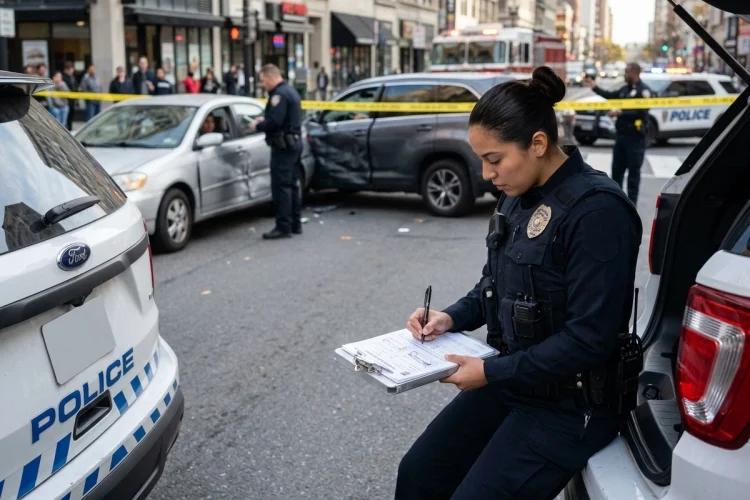
A police-style report may look simple on the surface, but writing a good one requires more than listing what happened.
The writer needs to transform observations, statements, actions, and evidence into a record that another person can understand without being at the scene.
Learning how to write clear and accurate police-style reports is especially useful for police students because reports can support investigations, supervisory review, court proceedings, and future follow-up.
The FBI Law Enforcement Bulletin describes report writing as a vital law-enforcement task and stresses that effective reports do not require complicated language.
The key is accuracy rather than drama. A strong report distinguishes what you personally observed from what another person told you and from conclusions that still need to be verified.
Police report formats and legal requirements vary between agencies and jurisdictions, but the core writing principles are remarkably consistent: record relevant facts, organise them logically, use plain language, and make your reasoning easy to follow.
1. Start With Facts, Not Conclusions
The most important rule in police-style writing is simple: describe what happened rather than what you assume happened.
Suppose you see a person strike a shop window several times with a metal object. Writing, “The man was trying to destroy the store because he was angry,” introduces assumptions about intention and emotion.
A more factual version would be:
“Smith struck the front window three times with a metal object approximately 40 centimetres long.”
Now the reader knows what you actually observed.
This distinction matters because police reports may later be reviewed by supervisors, investigators, lawyers, courts, or other people who were not present. FBI guidance recommends straightforward, factual writing rather than unnecessary attempts to sound sophisticated or impressive.
Whenever possible, ask yourself: Could another person independently verify what I just wrote?
If not, make clear whether the information is an observation, a statement, or an inference.
2. Organise the Report in a Logical Timeline
A reader should not have to solve a puzzle to understand your report.
For many incidents, chronological structure works well. Begin with why you became involved, explain what happened when you arrived, describe what you observed and learned, and finish with the actions taken.
For example, a basic narrative might move from dispatch, to arrival, to initial observation, to witness contact, to evidence collection, and finally to the outcome.
California POST’s investigative report-writing curriculum treats report organisation and documentation as core parts of basic peace-officer training. Its current basic-course materials include a dedicated learning domain for investigative report writing.
Chronology becomes especially useful when several events occur close together.
Instead of jumping from 9:15 p.m. to 9:40 p.m. and then back to 9:20 p.m., keep events in sequence whenever possible. If you must discuss an earlier event later, clearly explain the shift.
A clean timeline makes complicated incidents easier to understand.
3. Cover the Who, What, Where, When, How, and Why
A useful police report should answer the basic questions a future reader is likely to ask.
Who was involved? What happened? Where did it happen? When did it happen? How did events unfold? Why did you take particular actions?
California POST’s crime-scene training materials specifically describe notes as capturing information needed to address the who, what, where, when, how, and why of an incident.
The “why” deserves special attention.
If you conducted a particular action, do not simply write that you did it. Explain the relevant facts supporting your decision when appropriate.
Compare these two sentences:
“I stopped the vehicle.”
And:
“I stopped the vehicle after observing it travel through the red traffic signal at Main Street and Oak Avenue.”
The second sentence provides context.
Police-style writing should allow the reader to follow not only what happened but also the factual basis for significant actions.
4. Clearly Identify What Other People Said
Witness, victim, and suspect statements can become important parts of an investigation, but the report should make clear who provided each piece of information.
Instead of writing:
“The driver ran away after the crash.”
Write:
“Lopez stated that she saw the driver exit the vehicle and run east toward King Street.”
That small change tells the reader that you did not personally observe the driver running. You are recording Lopez’s account.
Direct quotations can be useful when the exact wording matters, but quotation marks should represent words you genuinely recorded or remember accurately.
An Office of Justice Programs summary on report writing recommends distinguishing others’ statements clearly and using quotation marks when recording what another person actually said.
Avoid Improving Someone’s Story
Do not quietly rewrite a witness’s uncertain statement into something more definite.
If a witness says, “I think the car was dark blue, but I’m not sure,” preserve that uncertainty.
Writing “The witness identified the vehicle as blue” changes the meaning.
Accuracy sometimes means admitting that information is incomplete.
5. Take Good Notes Before Writing the Final Narrative
Strong reports often begin with strong notes.
During an incident, details can accumulate quickly: times, names, addresses, descriptions, statements, property, evidence locations, vehicle information, and actions taken.
Relying entirely on memory creates unnecessary risk.
National Institute of Justice crime-scene guidance notes that documentation begins with the first responder and includes notes from the time of arrival.
Crime scenes may later be documented through photographs, video, sketches, and other methods to create an accurate representation of conditions.
Your notes do not need to read like the final report. Their purpose is to capture information accurately enough that you can later reconstruct events.
Record specific details while they are fresh.
If something is uncertain, mark it as uncertain rather than guessing.
College of Policing guidance also stresses the importance of retaining investigative notes where they may later form relevant material within an investigation.
Good notes make good reports easier to write.
6. Use Plain Language and Active Voice
Police-style reports should sound professional, but professional does not mean complicated.
Compare:
“I proceeded to the aforementioned location for the purpose of conducting an investigation.”
With:
“I went to 25 Hill Street to investigate the reported burglary.”
The second version is shorter and easier to understand.
FBI writing guidance recommends clear, concise professional writing and warns against outdated habits that make police reports unnecessarily complicated.
Active voice also usually makes responsibility clearer.
Instead of:
“The evidence was collected.”
Write:
“I collected the screwdriver from the floor beside the rear door.”
Now the reader knows who performed the action and where the evidence was located.
Avoid excessive police jargon too. A report may eventually be read by people outside law enforcement, so ordinary English is often the safest choice.
Clarity is more professional than complicated vocabulary.
7. Describe Evidence Precisely
If you mention evidence, describe it carefully.
Do not write “a weapon was found” if you can provide a more specific factual description such as “a black-handled kitchen knife approximately 20 centimetres long was located on the kitchen floor.”
Location matters too.
NIJ emphasises accurate crime-scene documentation because photographs, notes, sketches, and other records preserve relationships between evidence and the surrounding scene.
If evidence is collected, the report should follow applicable agency procedures concerning packaging, identification, transfer, and chain of custody.
NIJ defines chain of custody as the recorded method of showing where evidence travelled and who handled it before trial.
For students, the lesson is straightforward: never treat evidence descriptions as an afterthought.
A reader may later depend heavily on those details.
8. Review the Report for Accuracy and Neutrality
Finishing the last sentence does not mean the report is finished.
Read it again.
Check names, dates, addresses, times, vehicle registration numbers, evidence descriptions, and important quotations. Look for contradictions between one part of the report and another.
Also check your tone.
A 2024 NIJ-supported study examining language in police incident reports found that wording could reflect officer attitudes about victim credibility and potentially relate to later case outcomes.
That is a useful reminder that language matters.
Words such as “obviously,” “clearly lying,” “crazy,” or unnecessary judgments about someone’s character rarely improve factual reporting.
If credibility is relevant, document the facts that created the concern rather than simply attaching a label.
Finally, ask whether another officer could read your report six months later and understand exactly what happened.
If the answer is yes, you are probably close to a strong final version.
Learning how to write clear and accurate police-style reports is really about learning how to communicate facts responsibly.
Strong reports separate observations from assumptions, follow a logical timeline, identify information sources, describe evidence carefully, and explain significant actions with enough context for another reader to understand them.
Plain language usually works better than complicated terminology, while good field notes make accurate writing much easier. Careful review also helps catch missing details, inconsistencies, and unnecessary bias before the report is finalised.
If you are studying policing, practise by watching a short fictional scenario and writing a one-page report afterward.
Then review every sentence and ask: Did I observe this, did someone tell me this, or am I assuming it? That simple habit can dramatically improve report-writing discipline.