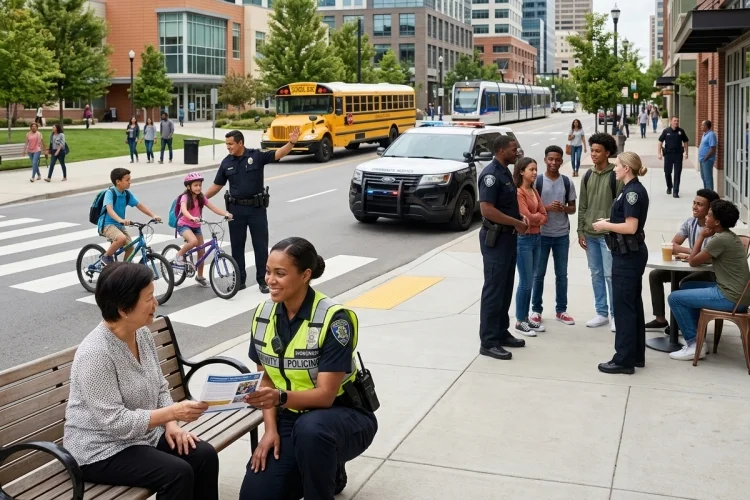
When people think about police officers, the first image that often comes to mind is someone responding to a crime, making an arrest, or directing traffic.
Those duties are certainly part of policing, but modern law enforcement involves much more than catching criminals.
Understanding what police officers do to serve modern communities means looking at a much broader range of responsibilities.
Officers respond to emergencies, investigate crimes, help vulnerable people, manage traffic incidents, work with schools and neighborhood groups, and increasingly deal with online fraud and digital threats.
Many departments also place greater emphasis on communication, de-escalation, transparency, and community partnerships.
The scale of police-public interaction shows how important these everyday responsibilities are. In the United States, about 49.2 million people aged 16 or older had at least one contact with police in 2022, according to the Bureau of Justice Statistics.
So, what does modern policing actually look like? Let’s explore the major ways police officers serve the communities around them.
1. Protecting People and Responding to Emergencies
Public safety remains one of the most important police officer responsibilities. Officers may be dispatched to burglaries, assaults, domestic disturbances, traffic crashes, missing-person reports, suspicious activity, and many other situations.
The work is unpredictable. An officer might begin a shift handling a minor traffic incident and later be called to a serious emergency where quick decisions can protect lives.
Police officers are often among the first professionals to arrive when something goes wrong. Their job may include securing dangerous areas, helping injured people, coordinating with firefighters or medical personnel, and gathering information from witnesses.
But emergency response is not simply about acting quickly. Officers must also assess whether a situation can be resolved through communication, whether additional specialists are needed, and how to reduce risks for everyone involved.
2. Preventing Crime Before It Happens
Modern policing is increasingly focused on prevention rather than waiting for crime to occur.
Officers may patrol areas experiencing repeated theft, vandalism, violence, or other public safety problems.
However, effective crime prevention can involve much more than increasing patrols. Police departments may analyze patterns, speak with residents, work with businesses, and identify environmental or social conditions contributing to recurring problems.
Problem-Solving Policing
Community policing encourages officers and residents to work together to identify the causes of local safety concerns.
The U.S. Department of Justice describes community policing through three major elements: community partnerships, problem solving, and organizational transformation.
Imagine a neighborhood experiencing repeated vehicle break-ins. Police could simply respond to reports after each incident.
A problem-solving approach might also examine where the thefts happen, whether lighting is poor, whether security cameras are available, and whether residents understand common prevention techniques.
The goal is not only to respond to crime but to reduce opportunities for it.
3. Investigating Crimes and Gathering Evidence
Another major part of what police officers do involves investigation.
Depending on their role, officers may interview victims, question witnesses, photograph crime scenes, collect evidence, review security footage, write detailed reports, and identify possible suspects.
Detectives often handle more complicated investigations, but patrol officers usually perform important early investigative work. What happens during the first few minutes after an incident can influence the entire case.
Modern investigations also increasingly involve digital evidence. Smartphones, social media accounts, financial transactions, security systems, and online communications can all become relevant.
This means law enforcement professionals need to understand both traditional investigative techniques and rapidly changing technology.
4. Building Trust Through Community Policing
Police cannot realistically address every safety issue without cooperation from the public. Residents often provide reports, witness statements, tips, video footage, and local knowledge that investigators would otherwise never receive.
That is why community trust has become such an important part of modern policing.
Officers may attend neighborhood meetings, speak at schools, meet business owners, participate in community events, or develop relationships with local organizations. These interactions allow residents to communicate concerns before they develop into larger problems.
Research on police legitimacy also emphasizes the importance of how officers interact with people. The National Institute of Justice notes that perceptions of legitimacy are influenced by whether people believe police act professionally, fairly, competently, and consistently.
In practice, that means listening carefully, explaining decisions when possible, treating people respectfully, and applying rules consistently can be just as important as enforcement itself.
5. Handling Mental Health and Crisis Situations
Modern police officers frequently encounter situations that are not traditional crimes.
Someone experiencing a severe mental health crisis, for example, may behave unpredictably without having criminal intentions. Officers may also encounter people dealing with homelessness, substance misuse, disabilities, or extreme emotional distress.
These situations require communication skills and careful judgment.
De-escalation training teaches officers techniques designed to slow situations down, improve threat assessment, and reduce the likelihood that an encounter develops into a physical confrontation.
The U.S. Department of Justice has expanded training initiatives covering de-escalation, behavioral health crises, crisis intervention teams, and referrals to community-based services.
Police may also work alongside mental health professionals, emergency medical services, social workers, and community organizations.
The broader lesson is important: sometimes the safest solution is not an arrest but connecting someone with the right form of assistance.
6. Keeping Roads and Public Spaces Safer
Traffic enforcement is another highly visible police responsibility.
Officers respond to crashes, investigate dangerous driving, assist stranded motorists, manage traffic around emergencies, and enforce rules involving speeding, impaired driving, seat belts, and other road safety issues.
Traffic stops also represent a significant portion of police-public encounters. Bureau of Justice Statistics data show that millions of U.S. residents interact with police through traffic-related situations each year.
Beyond roads, officers may help maintain safety during festivals, sporting events, demonstrations, concerts, and other large gatherings.
These situations require planning as well as enforcement. Police may coordinate traffic routes, emergency access, crowd movement, and communication with event organizers to reduce potential problems before they occur.
7. Responding to Cybercrime and New Technology
Crime is no longer limited to physical streets and neighborhoods.
Online scams, identity theft, phishing, cyberstalking, financial fraud, hacking, and cryptocurrency-related schemes have created new challenges for law enforcement agencies.
The FBI reported that its Internet Crime Complaint Center received 859,532 complaints in 2024, with reported losses exceeding $16.6 billion.
That type of crime can require cooperation between local police, national agencies, financial institutions, technology companies, and investigators in other jurisdictions.
Technology also helps officers perform traditional duties. Body-worn cameras, digital reporting systems, license plate readers, mapping software, and crime analysis tools can improve documentation and investigations when used under appropriate policies.
At the same time, these technologies raise important questions about privacy, transparency, data security, and accountability. Modern police departments therefore have to balance technological capability with public trust and legal protections.
8. Why Communication Matters as Much as Enforcement
Police work is ultimately a people-focused profession.
Officers regularly communicate with victims who are frightened, witnesses who are confused, drivers who are frustrated, families experiencing conflict, and residents who simply want answers.
A technically correct response can still damage trust if people feel they were ignored or treated unfairly. On the other hand, respectful communication can make difficult encounters easier even when officers still need to enforce the law.
This is why skills such as active listening, cultural awareness, conflict resolution, emotional control, and clear communication have become increasingly important in law enforcement training.
Good policing is not only about authority. It is also about knowing when to listen, when to explain, when to intervene, and when another community service may be better equipped to solve the underlying problem.
Understanding what police officers do to serve modern communities reveals a profession that extends far beyond arrests and emergency sirens.
Officers protect people, investigate crimes, prevent recurring problems, manage traffic, respond to crises, address digital threats, and build relationships with residents.
Modern policing also depends increasingly on communication, fairness, technology, de-escalation, and partnerships with other public services.
No police department can solve every community problem alone, which makes cooperation between officers, residents, businesses, schools, healthcare providers, and local organizations essential.
If you want safer communities, learning how policing actually works is a useful starting point. Stay informed about local public safety programs, participate in community discussions, and understand how residents and police can work together to address problems before they grow.