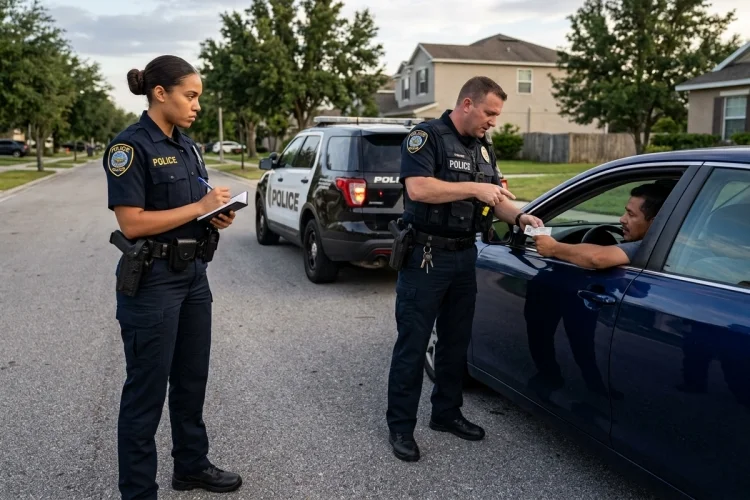
Police work is built on more than uniforms, patrol procedures, and tactical skills. Every decision an officer makes-from stopping someone on the street to searching a vehicle or making an arrest-has a legal foundation.
That is why understanding the basic legal principles every police student should know is essential long before a recruit begins working independently.
Knowing the law helps officers recognize what they are allowed to do, where their authority ends, and how individual rights must be protected during an investigation.
A simple mistake can have major consequences. Evidence obtained through an unlawful search may face suppression, an improper interrogation can create problems for a prosecution, and an unreasonable use of force can raise constitutional and civil liability issues.
In the United States, many of these rules come from the Fourth, Fifth, Sixth, and Fourteenth Amendments, together with court decisions interpreting them.
This article uses U.S. law as its main example. Police students elsewhere should always compare these principles with the laws and procedures of their own jurisdiction.
1. The Rule of Law Comes Before Police Authority
One of the first lessons for any police student is surprisingly simple: having authority does not mean having unlimited authority.
The rule of law means government officials, including police officers, must operate within legal boundaries. An officer cannot stop, search, detain, or arrest someone simply because doing so feels useful. There must be a lawful basis for government action.
For police students, this changes the way everyday situations should be analyzed. Instead of asking only, “What should I do?” a future officer should also ask, “What legal authority allows me to do it?”
This mindset is especially important because police officers regularly make decisions that affect liberty and privacy. The Fourth Amendment, for example, protects people against unreasonable searches and seizures and requires probable cause for warrants.
Good policing therefore begins with knowing both your powers and their limits.
2. Understand Reasonable Suspicion and Probable Cause
Two terms appear constantly in police training: reasonable suspicion and probable cause. They are related, but they are not interchangeable.
Reasonable suspicion is generally associated with brief investigative stops. Following Terry v. Ohio, U.S. constitutional doctrine allows certain investigative stops when an officer has reasonable suspicion that criminal activity is occurring.
The important word is specific. A police officer should be able to point to observable facts and explain why those facts created suspicion. A vague feeling or unsupported hunch is not the same thing.
Imagine an officer sees someone repeatedly looking through parked car windows at 3 a.m., trying several door handles, and walking away whenever another vehicle approaches. The combination of circumstances matters more than simply saying, “He looked suspicious.”
Probable cause is a higher threshold commonly associated with arrests and search warrants. The Fourth Amendment specifically requires probable cause before a warrant may issue.
Police students should practice explaining the facts supporting their decisions, because legal justification often depends heavily on what the officer knew at the time.
3. Search and Seizure Rules Are Essential
Search law is one of the most important-and sometimes complicated-areas of police education.
Under the Fourth Amendment, people are protected against unreasonable searches and seizures. Warrants generally require probable cause and must particularly describe the place to be searched and the persons or things to be seized.
That does not mean every police search requires a warrant. U.S. law recognizes several circumstances in which warrantless searches may be lawful, depending on the situation. However, each exception has its own requirements and limits.
For a student, memorizing the names of search exceptions is not enough. The real skill is learning to recognize which rule applies to a particular set of facts.
Suppose officers arrive at a house and hear someone screaming for help inside. That situation raises very different legal questions from an officer wanting to search a residence simply because the occupant is suspected of possessing stolen property.
Police recruits should therefore learn to slow down mentally and identify the legal justification before conducting a search whenever circumstances allow.
4. Know the Difference Between a Stop, Detention, and Arrest
Not every police encounter has the same legal significance.
A voluntary conversation, an investigative detention, and an arrest involve different levels of police authority. Understanding when an encounter changes from one category to another is critical because different legal requirements may apply.
For example, an investigative stop under Terry is connected to reasonable suspicion, while arrests generally require probable cause.
Police students should also understand that what officers call an encounter is less important than what actually happens. Simply saying, “You are not under arrest,” does not automatically settle every legal question if the person’s freedom has been significantly restricted.
This is where clear communication becomes valuable. Officers should know how to explain what is happening, document the reasons for their actions, and recognize when the legal character of an encounter changes.
Understanding these distinctions protects both investigations and individual rights.
5. Miranda Rights Do Not Apply to Every Police Conversation
Few legal concepts are as famous—or misunderstood—as Miranda rights.
Movies sometimes make it seem as though police officers must immediately read Miranda warnings whenever they speak with a suspect. The actual rule is more specific.
Under U.S. constitutional doctrine following Miranda v. Arizona, warnings are generally required when two conditions come together: a person is in custody and is subjected to interrogation.
That means a police student needs to understand both concepts rather than simply memorize the warning.
The Fifth Amendment also protects against compelled self-incrimination and guarantees that a person cannot be deprived of life, liberty, or property without due process of law.
A practical lesson is that interrogation should never be treated as simply “asking questions.” Officers must recognize when constitutional protections have been triggered and follow the applicable procedures.
Good investigators understand that legally obtained evidence is far more valuable than information collected through shortcuts.
6. Due Process and the Right to Counsel Matter
Police officers are one part of a much larger criminal justice system.
After an arrest, prosecutors, defense lawyers, courts, and juries may become involved. Police students therefore need at least a basic understanding of the rights that continue throughout the criminal process.
The Fifth Amendment includes the guarantee of due process, while the Sixth Amendment provides important protections in criminal prosecutions, including the right to a speedy and public trial, confrontation of witnesses, notice of accusations, and assistance of counsel.
These protections affect police work because investigations eventually have to survive legal scrutiny.
An officer’s report may be examined by prosecutors and defense lawyers. Evidence may be challenged. Statements may be questioned. Officers themselves may later testify about exactly what they saw, said, or did.
Police students should therefore learn early that professionalism does not end after an arrest. Their actions may become part of a court case months or even years later.
7. Use of Force Must Have a Legal Justification
The authority to use force carries enormous responsibility.
In U.S. constitutional law, claims involving police force against free citizens are generally evaluated under the Fourth Amendment’s objective reasonableness framework associated with Graham v. Connor.
This means police students should not think about force simply as a list of techniques they are trained to perform. They must understand when force is legally justified and how the circumstances affect what level of force may be reasonable.
Modern policy also increasingly emphasizes de-escalation. The U.S. Department of Justice’s federal law-enforcement policy directs officers to use de-escalation tactics when objectively feasible and when doing so would not increase danger.
The policy also includes duties to intervene against excessive force and to request or provide medical assistance where appropriate.
For students, the practical lesson is clear: communication, distance, time, positioning, and judgment can be as important as physical tactics.
The best outcome is often the one that safely resolves the incident with the least force reasonably necessary.
8. Evidence and Documentation Can Make or Break a Case
Police work does not end when evidence is discovered.
Officers must document where evidence was found, how it was collected, who handled it, and what happened afterward. Reports should separate observations from assumptions and explain the facts supporting important decisions.
The legal importance of proper procedure becomes obvious when considering the exclusionary rule. U.S. constitutional doctrine allows courts, in certain circumstances, to exclude evidence obtained through violations of Fourth Amendment protections.
That makes attention to detail essential.
Imagine an officer finds critical evidence but cannot clearly explain why the search was lawful. Even strong evidence can create legal problems when its method of discovery is challenged.
Police students should develop the habit of writing accurate, chronological, fact-based reports from the beginning of their training. Avoid exaggeration and vague phrases when specific observations are available.
A well-written report does more than satisfy paperwork requirements. It helps investigators, prosecutors, courts, and even the officer remember exactly what happened.
Learning the basic legal principles every police student should know is not about memorizing hundreds of court cases overnight. It is about developing a habit of connecting every police action to lawful authority.
Future officers should understand the rule of law, reasonable suspicion, probable cause, search and seizure requirements, arrest powers, Miranda protections, due process, the right to counsel, use-of-force standards, and proper evidence handling.
These principles protect individual rights while also helping officers conduct stronger investigations and make better decisions under pressure.
If you are studying for a career in law enforcement, start applying legal concepts to realistic scenarios instead of relying on memorization alone. Ask yourself what authority applies, what facts justify the action, and how you would explain your decision clearly in a report or courtroom.