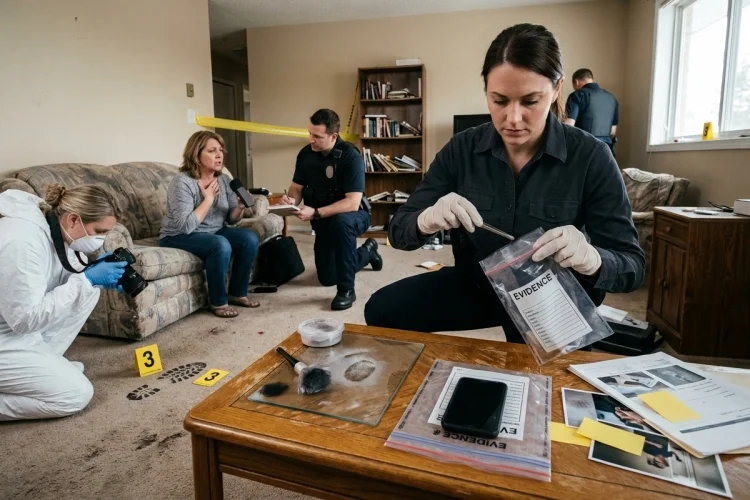
When people hear the word “evidence,” they often imagine fingerprints, DNA, or a suspicious object sealed inside a plastic evidence bag.
In reality, investigators may work with many different kinds of information, including witness statements, photographs, documents, video recordings, digital data, and physical material collected from a scene.
Understanding what counts as evidence in a basic police investigation is important because evidence helps investigators reconstruct events rather than simply relying on assumptions.
The National Institute of Justice broadly distinguishes testimonial evidence-such as statements from victims or witnesses-from physical evidence such as fingerprints, biological material, hair, and fibres.
Modern investigations can also involve digital evidence from phones, computers, cameras, and online activity. Finding evidence, however, is only the beginning. Investigators must also document, preserve, evaluate, and legally obtain it.
Specific evidence rules vary by jurisdiction, so this article uses general investigative principles and U.S. examples rather than offering jurisdiction-specific legal advice.
1. Physical Evidence Includes Objects and Material From a Scene
Physical evidence is probably the easiest category to recognise because it consists of tangible material that investigators can potentially collect, photograph, measure, or examine.
The National Institute of Justice lists examples such as fingerprints, footprints, tyre tracks, blood and other body fluids, hair, fibres, and fire debris.
Trace evidence may also include materials such as glass fragments and paint chips, while comparative evidence can include fingerprints and tool marks.
Imagine a burglary at a shop.
Investigators might find a broken window, a shoe impression near the entrance, fingerprints on a display case, and a tool left behind. None of these items automatically proves who committed the offence.
Instead, each piece becomes part of a larger puzzle.
Physical evidence becomes useful when investigators can connect it logically to the incident, compare it with other information, and preserve it properly for later examination.
2. Witness and Victim Statements Are Evidence Too
Evidence does not need to be something investigators can place in a bag.
Statements from victims and witnesses are commonly described as testimonial evidence. NIJ specifically identifies spoken statements from victims or witnesses as one major category of evidence.
Suppose three people see a vehicle leave the scene of a robbery.
One remembers the colour. Another remembers part of the licence plate. A third saw which direction it travelled.
Each statement provides potentially useful information.
However, investigators should not assume that every witness remembers an event perfectly. People may observe different details, misunderstand what they saw, or remember events differently.
That is why witness accounts are usually considered alongside other information rather than automatically treated as complete proof.
A good basic investigation asks: What did the witness personally observe, and what part of the story is interpretation or assumption?
3. Photos, Video, and Documents Can Support an Investigation
Documentary evidence covers another broad area.
Depending on the case, relevant material might include receipts, contracts, handwritten notes, business records, photographs, maps, transaction records, or other documents.
Video can be particularly useful in modern investigations.
A security camera might show when a person entered a building, what clothing they wore, which vehicle they used, or how events unfolded.
But investigators still have to ask basic questions.
Where did the video come from? Does the timestamp appear accurate? Is the recording complete? Who provided it? Has the original file been preserved?
The importance of authenticity becomes especially relevant when evidence reaches court. The Federal Rules of Evidence governing U.S. federal proceedings include requirements dealing with relevance and authentication or identification of evidence.
In other words, possessing a photograph or document is not always enough. Investigators may also need to establish what it is and where it came from.
4. Digital Evidence Is Now Part of Everyday Policing
Digital evidence is no longer limited to specialist cybercrime investigations.
Phones, computers, smart devices, security systems, online accounts, GPS-related information, messages, photographs, and other electronic records can potentially become relevant in many types of cases.
The FBI notes that digital evidence can contribute to investigations involving many forms of crime, not only offences normally described as cybercrime.
Consider a missing-person investigation.
A phone may potentially contain messages, photographs, account activity, or other information relevant to establishing a timeline, subject to applicable legal authority and investigative procedures.
Digital evidence creates special preservation challenges because data can be altered, deleted, duplicated, or overwritten. FBI guidance stresses maintaining secure storage, backups, authenticity, and the long-term integrity of digital material.
For police students, the key lesson is not to casually explore electronic devices.
Digital evidence should be handled according to law, agency policy, and appropriate forensic procedures.
5. Forensic Evidence Uses Science to Examine Physical Material
Forensic evidence is often physical evidence that has been scientifically examined.
DNA is a familiar example, but forensic work covers many other disciplines.
NIJ describes pattern-related forensic evidence that may include fingerprints, footwear impressions, firearm-related markings, and bloodstain patterns. Crime-scene evidence can also include biological materials and trace evidence that may later undergo laboratory analysis.
The important point is that forensic evidence usually requires interpretation.
Finding a fingerprint at a scene, for instance, may establish that a particular person’s print is present in a location, but investigators still need context. Was that person legitimately there earlier? When might the print have been deposited?
Evidence rarely explains an entire case by itself.
Good investigators combine scientific findings with timelines, witness information, digital records, and other facts.
6. Crime Scene Documentation Can Become Important Evidence
Investigators do not simply collect objects. They document where those objects were found and how the scene appeared.
NIJ guidance says crime-scene investigators commonly use photographs, video, sketches, measurements, and written documentation to preserve an accurate representation of a scene.
Location can completely change the meaning of an object.
A knife discovered in a kitchen drawer has a different investigative context from the same knife found beside an injured person.
That is why moving items before documenting them can create problems.
Crime-scene guidance also stresses controlling and documenting who enters or exits the scene and carefully identifying possible evidence locations.
For a police student, one of the most useful habits is simple: observe and document before disturbing anything unless immediate safety or lifesaving needs require action.
The condition of the scene may be just as informative as the objects inside it.
7. Chain of Custody Protects the Integrity of Evidence
Imagine an officer collects an important item, but nobody records who handled it afterward.
That creates an obvious question: how can investigators later demonstrate that the item presented for examination is the same one originally collected?
This is where chain of custody becomes important.
NIJ explains that crime-scene investigators maintain the proper chain of custody for evidence they collect.
Documentation can record transfers, handling, examinations, storage, and other important stages in an item’s history. DOJ materials likewise reference chain-of-custody logs as part of evidence-related documentation.
A basic example might look like this:
An officer collects an item, packages and labels it, records the collection, transfers it to secure evidence storage, and later documents its transfer to a forensic laboratory.
Every important movement is traceable.
Chain of custody does not determine whether an item proves guilt. It helps demonstrate that the integrity and identity of the evidence have been maintained.
8. Relevant Evidence Is Different From Interesting Information
Investigators can collect enormous amounts of information, but not everything connected to a person or location is necessarily relevant.
A useful question is: Does this information actually help establish something important about the case?
Under the U.S. Federal Rules of Evidence, information is relevant when it has a tendency to make a fact of consequence more or less probable than it would otherwise be.
Court admissibility involves additional rules, but the concept provides a useful mindset for basic investigations.
Imagine police investigate a stolen bicycle.
A suspect’s favourite music probably tells investigators nothing useful. Security footage showing that person entering the bicycle storage area shortly before the theft could be much more relevant.
This helps police students avoid a common mistake: collecting information simply because it seems interesting.
Effective investigations focus on facts that help establish what happened, when it happened, where it happened, who was involved, and how the available evidence supports or challenges possible explanations.
Understanding what counts as evidence in a basic police investigation means looking far beyond fingerprints and DNA.
Evidence can include physical objects, witness statements, documents, photographs, surveillance footage, digital information, forensic findings, and accurate crime-scene documentation.
However, finding something potentially important does not automatically make an investigation strong. Evidence must be lawfully obtained, properly documented, preserved, evaluated in context, and handled in a way that protects its integrity.
For police students, start practising one simple habit: separate what you know from what you assume. Ask where each piece of information came from, how it relates to the incident, and whether another explanation fits the facts.
Strong investigations are rarely built around one dramatic clue. They are built by carefully connecting reliable pieces of evidence.