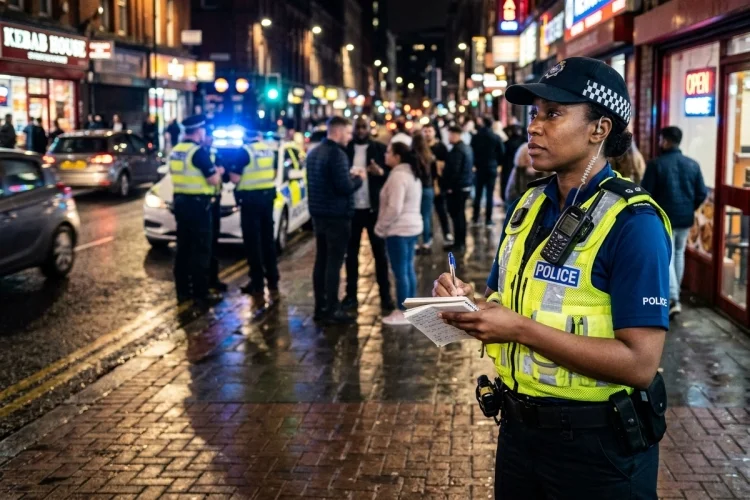
Police officers often have to make decisions with incomplete information. They may arrive at a noisy argument, investigate suspicious behaviour, speak with conflicting witnesses, or respond to an incident where nobody agrees about what happened.
In situations like these, one skill becomes especially important: careful observation.
Understanding how careful observation supports fair police decisions means recognising the difference between what an officer actually sees, hears, and verifies-and what they assume those details mean.
Good observation can improve investigations, strengthen reports, reduce the influence of bias, and help officers explain why they chose a particular action.
Modern police decision-making frameworks reflect this principle. The College of Policing’s National Decision Model begins with gathering information and intelligence before moving through threat assessment, powers, options, and action.
Observation sounds simple, but doing it well requires practice. Police officers must notice important details while remaining open to information that might challenge their first impression.
That combination of attention and open-mindedness can support decisions that are safer, more accurate, and fairer.
1. Observe Before You Interpret
One of the easiest mistakes in any investigation is turning an observation into a conclusion too quickly.
Imagine an officer sees a person repeatedly looking toward a closed shop late at night. Saying, “The person looked toward the shop several times” describes observable behaviour.
Saying, “The person was preparing to commit a burglary” is an interpretation.
The interpretation could eventually prove correct, but more information is needed.
Careful police observation encourages officers to collect details before deciding what those details mean. What exactly did the person do? How long were they there? Were they carrying anything? Was there another reasonable explanation?
Critical thinking is closely connected to this process. The FBI Law Enforcement Bulletin warns that deciding someone “knows at a glance” what happened can contribute to confirmation bias, where contradictory information may be overlooked after an initial conclusion has formed.
Good observation therefore begins with curiosity rather than certainty.
2. Separate Facts From Assumptions
Police students can improve their observation skills by learning to divide information into three categories: what they personally observed, what another person reported, and what they currently believe may have happened.
Those categories should not be mixed together.
Suppose an officer arrives after two vehicles collide.
The officer can observe damaged vehicles, road conditions, tyre marks, traffic signals, and where debris is located. Witnesses can provide their own accounts. The officer may later form an opinion about what caused the collision.
Each piece of information has a different source.
Keeping those sources clear helps prevent assumptions from quietly becoming “facts.”
This principle also improves police report writing. The FBI Law Enforcement Bulletin explains that reports serve important purposes, including recording information and supporting investigations, and recommends straightforward language rather than unnecessarily complicated wording.
Instead of writing, “The suspect appeared guilty,” a stronger report describes the specific behaviour the officer actually observed.
Precise observations give other people something they can evaluate independently.
3. Careful Observation Can Help Reduce Bias
No person observes the world with a completely empty mind.
Previous experiences, expectations, stereotypes, emotions, and assumptions can influence what people notice and how they interpret uncertain situations.
For police officers, recognising that possibility matters because their decisions can affect people’s freedom, safety, and treatment within the justice system.
The College of Policing specifically warns that different forms of bias can influence investigative decision-making. Its guidance recommends impartiality, awareness of bias, and recording the reasoning behind decisions so actions can be justified and reviewed.
A practical way to challenge bias is to return to observable information.
Ask: What facts support my conclusion? What information contradicts it? What else could explain what I am seeing?
The U.S. Department of Justice also identifies recognising biases, assumptions, and stereotypes as an important principle in improving law-enforcement responses to victims.
This does not mean officers should ignore experience or intuition.
Experience can help someone notice potential danger quickly. But experience works best when the initial impression is tested against facts instead of automatically being treated as proof.
4. Open-Minded Observation Improves Investigations
Investigations often begin with uncertainty.
Police may have several witnesses, incomplete physical evidence, different possible suspects, or competing explanations for what occurred.
The danger is becoming attached to one theory too early.
College of Policing guidance on effective investigations says open-mindedness helps investigators work effectively and protects against confirmation bias.
Imagine that an investigator initially believes a burglary was committed by someone familiar with the building.
That may be a reasonable theory. However, the investigator should still consider evidence pointing elsewhere.
Was a window forced from outside? Were unfamiliar fingerprints or digital records found? Did surveillance footage show someone unknown to staff?
A strong investigator should be willing to change direction when new evidence demands it.
This is an important lesson for police students: changing your conclusion after receiving better information is not weakness.
It is evidence-based decision-making.
Good observation therefore includes noticing not only information that supports your theory but also details that make your theory less convincing.
5. Accurate Observation Creates Better Police Reports
Memory is useful, but police officers should not expect memory alone to preserve every important detail from a complicated incident.
This is why careful observation and documentation work together.
Officers may need to record descriptions, locations, times, statements, environmental conditions, injuries, property damage, and actions taken during an incident.
California POST’s current Regular Basic Course includes dedicated training in investigative report writing, presentation of evidence, patrol techniques, crime scenes, and other areas where accurate observation and documentation are essential.
A useful practical habit is to write specific details instead of vague conclusions.
Instead of:
“The driver was acting strangely.”
A report could explain:
“The driver repeatedly dropped the vehicle documents, spoke slowly, and had difficulty following instructions.”
The second description gives supervisors, investigators, lawyers, and courts much more useful information.
Good documentation also makes police decisions easier to review later.
An officer may remember why a decision seemed reasonable during a stressful incident, but someone reading the report months later needs the relevant facts written down clearly.
6. Observation Supports Procedural Justice and Fair Treatment
Fair policing is not only about reaching the correct final decision.
The process matters too.
Procedural justice research focuses on whether people believe police procedures and interactions are fair.
An Office of Justice Programs systematic review found benefits associated with police dialogue incorporating principles of procedural justice and linked legitimacy with greater capacity for cooperation and effective policing.
Careful observation supports this idea because officers who gather information patiently are less likely to treat one person’s version of events as automatically correct.
Consider a neighbourhood dispute.
If an officer arrives and immediately decides who is responsible based on who appears angrier, important context may be missed. Listening to both people, looking for independent evidence, identifying witnesses, and asking neutral questions creates a more balanced process.
That does not guarantee everyone will like the final decision.
A person may still receive a citation, be arrested, or disagree with what the officer decides.
But decisions based on observable facts, impartial information gathering, and clearly explained reasoning are easier to defend as fair.
7. Observation Is a Skill Police Students Can Practise
Some people naturally notice details, but observation is also trainable.
Police students can practise by studying everyday scenes and then describing them without adding assumptions.
Watch a short video once, for example, and write down what happened. Then compare your notes with the video.
You may discover that you remembered the main event but missed clothing, direction of travel, sequence, objects, or environmental details.
Another useful exercise is separating fact from inference.
“The man closed the door quickly” is an observation.
“The man closed the door because he was hiding something” is an inference.
Students can also practise considering alternative explanations. If three explanations could reasonably fit the same behaviour, what additional information would help distinguish between them?
Police decision-making models encourage this structured thinking. The College of Policing’s National Decision Model places information gathering, assessment, ethical considerations, powers and policies, options, and review within the same continuous decision process.
The goal is not to observe everything.
No human can.
The goal is to notice relevant information, remain aware of uncertainty, and keep updating your understanding as new facts appear.
Understanding how careful observation supports fair police decisions reveals why attention to detail is much more than an investigative skill.
Good observation helps officers separate facts from assumptions, challenge bias, evaluate competing explanations, document incidents accurately, and explain why they made particular decisions.
Fair policing does not require officers to know everything immediately. It requires them to remain curious enough to gather information before reaching conclusions and disciplined enough to reconsider those conclusions when evidence changes.
For police students, this skill can begin with simple practice. Describe what you actually see, identify what you only assume, look for information that challenges your first impression, and explain the evidence behind your decision.
The better you become at observing before judging, the stronger your foundation for thoughtful and professional police work.