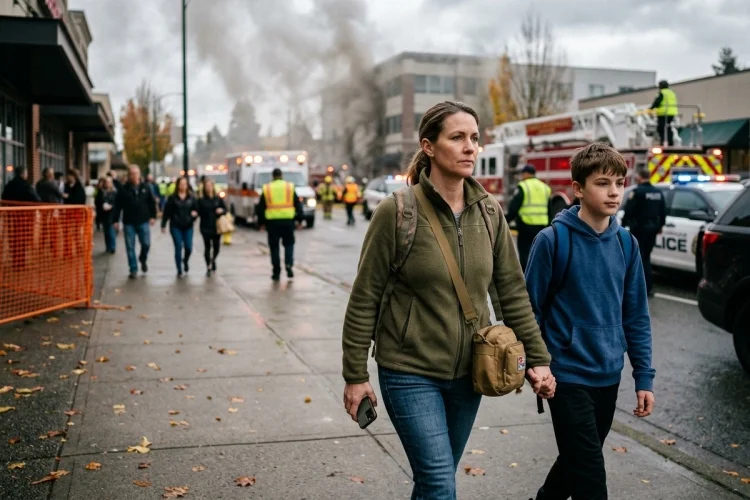
Emergencies rarely arrive at a convenient moment. A fire alarm goes off, severe weather suddenly approaches, someone gets injured, or an evacuation order appears on your phone.
In those first few seconds, fear and confusion can make even simple decisions feel surprisingly difficult.
Learning how to stay calm and make safer choices in emergencies does not mean training yourself to feel no fear. Stress is a normal response to danger. The real goal is to control your reaction long enough to understand what is happening and choose a sensible next step.
The CDC notes that preparation and planning before an emergency can increase confidence and help people remain calmer when stressful situations occur.
FEMA’s Ready campaign teaches a similarly simple idea: stay safe, stay calm, get help, provide useful information, and give appropriate care when possible.
You cannot control every emergency, but you can improve how prepared you are to respond.
1. Control Your First Reaction
When something suddenly goes wrong, the instinctive reaction may be to run, shout, freeze, or immediately copy whatever everyone else is doing.
Sometimes fast action is necessary. However, when you have even a few seconds and are not in immediate danger, use them to orient yourself.
Take a deliberate breath and ask: What is happening right now?
The CDC includes deep breathing among healthy techniques that can help people manage stress. In an emergency, the purpose is not to spend several minutes doing a relaxation exercise. It is simply to prevent panic from controlling your next decision.
Then focus on the immediate situation rather than everything that could possibly go wrong.
Is there fire? Moving traffic? Floodwater? Falling debris? An injured person? An official warning?
Once you identify the most immediate danger, the next step becomes easier to choose.
2. Check Whether the Scene Is Safe
Before rushing to help someone, look for hazards that could make you another victim.
This principle is especially important in first aid. The American Red Cross begins its general first-aid steps by telling responders to check the scene for safety before approaching and providing care.
Imagine seeing someone injured after a traffic collision.
Running directly into the road without checking approaching vehicles could create another emergency. Similarly, entering a smoke-filled building to retrieve belongings can expose you to serious danger.
Help Without Creating Another Casualty
Helping does not always mean moving closer.
Sometimes the safest action is calling emergency services, warning other people away, following an evacuation order, or waiting for trained responders with suitable protective equipment.
A useful rule is: protect yourself first, then help others when it is reasonably safe to do so.
That is not selfish. A person who becomes injured while attempting an unsafe rescue may make the situation more difficult for everyone.
3. Identify the Most Important Problem First
Emergencies create information overload.
People may be shouting. Phones may be ringing. Alarms may be sounding. Several things may appear to need attention at once.
Do not try to solve everything simultaneously.
Prioritise threats to life and immediate safety first. Property, schedules, personal belongings, and inconvenience usually come later.
For example, during a building evacuation, retrieving a laptop or searching for a favourite bag should not take priority over leaving safely when authorities tell you to evacuate.
The same thinking applies to medical emergencies. The Red Cross uses the simple framework Check, Call, Care: check the situation and person, contact appropriate emergency help, and provide care within your training and ability.
Simple frameworks are valuable because stressed people have fewer decisions to invent from scratch.
4. Follow Trusted Emergency Alerts and Instructions
Rumours spread quickly during emergencies, especially through social media and group chats.
One person says a road is open. Another says everyone must evacuate. Someone forwards an old photo and claims it was taken five minutes ago.
That confusion can lead to unsafe choices.
Use official emergency alerts, local authorities, emergency services, weather agencies, or other trusted sources whenever possible.
Ready.gov explains that emergency warning systems can provide information about hazards and protective actions during disasters. Its guidance also covers alerts delivered through television, radio, and mobile emergency-warning systems.
If officials tell you to evacuate, shelter indoors, avoid a particular road, or move to higher ground, take the instruction seriously.
Do not delay simply because conditions around you still look normal. Warnings are often issued because a danger is approaching rather than because it is already visible from where you are standing.
5. Communicate Clearly and Briefly
Good communication can save valuable time.
When contacting emergency services, give information in a simple order: where you are, what happened, what danger is present, and whether anyone appears injured or trapped. Then listen carefully to the operator’s instructions.
Avoid guessing.
If you do not know whether someone is breathing normally, say you are unsure rather than giving false information.
Communication also matters within families. During a disaster, mobile networks may become congested and family members may be in different locations.
Ready.gov recommends creating a family emergency communication plan in advance so household members know how to contact each other, where to meet, and what to do if they become separated.
That planning eliminates a major question during a stressful event: “Where is everyone?”
6. Avoid Heroic but Unnecessary Risks
Movies make emergencies look dramatic. Real safety is often much less exciting.
You usually do not need to become the hero who runs toward every danger.
Do not enter unstable buildings, approach hazardous materials, touch damaged electrical equipment, drive through floodwater, or perform medical procedures beyond your training simply because you feel pressure to “do something.”
Sometimes the smartest response is creating distance and calling people who have the equipment and skills to handle the situation.
The same principle applies to first aid.
Provide help within your knowledge and training while following instructions from emergency professionals.
Formal first-aid and CPR training can make you much more useful when a real emergency occurs; the Red Cross specifically encourages emergency preparedness alongside first-aid and CPR education.
Courage and recklessness are not the same thing.
Good emergency decision-making protects as many people as possible without creating unnecessary additional risks.
7. Prepare Before Stress Makes Decisions Harder
One of the easiest ways to remain calmer during emergencies is to make important decisions beforehand.
Where will your family meet if you cannot return home? Who will collect the children? Which route will you use if the main road is blocked? Where are medications and important documents stored?
Ready.gov recommends discussing communication, shelter, evacuation routes, and household needs when creating an emergency plan.
An emergency supply kit is another useful preparation.
FEMA recommends supplies that can help households manage independently for several days after a disaster. Basic items can include water, non-perishable food, flashlights, batteries, communication equipment, medications, and other household-specific necessities.
The purpose is not to prepare for every imaginable disaster.
It is to remove predictable problems so you have fewer things to figure out while under pressure.
8. Practice Decisions Before You Need Them
Reading emergency instructions once is helpful. Practising them is better.
Families can rehearse evacuation routes. Schools and workplaces can run drills. People can learn first aid and CPR. Drivers can keep emergency supplies in their vehicles.
Practice helps familiar actions come to mind faster during stressful situations.
Ready.gov’s emergency-preparedness materials encourage families to create plans before disasters, while its youth programmes specifically teach simple steps such as staying safe, staying calm, getting help, providing information, and giving care.
Even a short discussion can be useful.
Ask your family, “What would we do if we had to leave the house tonight?” Then identify the biggest gaps.
Perhaps nobody knows where the flashlight is. Maybe an important medication would be forgotten. Perhaps family members have never agreed on a meeting location.
Fixing those small problems now creates fewer decisions during an actual emergency.
Learning how to stay calm and make safer choices in emergencies is not about becoming fearless.
It is about replacing panic with a simple process: recognise the danger, protect yourself, prioritise the most urgent problem, follow trusted instructions, communicate clearly, and avoid unnecessary risks.
Preparation makes that process much easier. A family plan, emergency contacts, reliable alerts, basic supplies, and first-aid knowledge can reduce confusion when every second feels important.
Start with one simple action today. Review your household emergency plan-or create one if you do not have it. Make sure everyone knows whom to contact, where to meet, and how to receive official alerts.
You cannot predict every emergency, but you can make your next decision safer before the emergency ever begins.