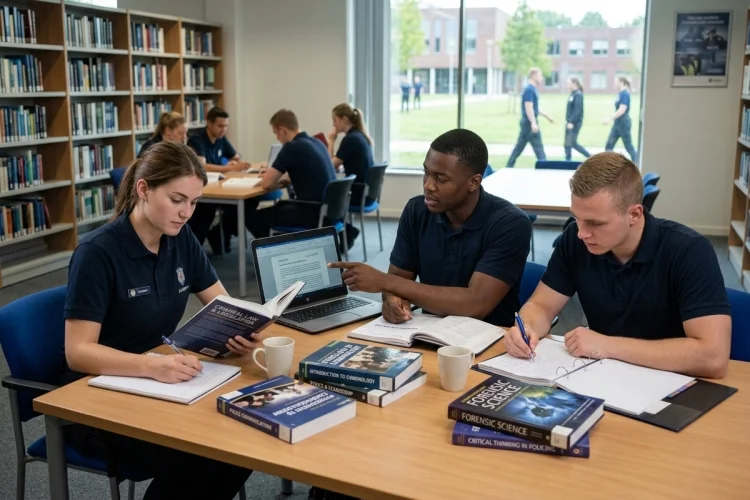
Preparing for police education is not only about running faster, getting stronger, or learning defensive techniques.
Long before students enter an academy or criminal justice programme, the academic skills they develop can make a major difference in how successfully they understand law, analyse evidence, write reports, and make decisions.
The academic skills that support future police education are surprisingly broad. Strong reading comprehension helps students understand legislation and policies.
Clear writing becomes essential when documenting incidents. Critical thinking helps future officers separate facts from assumptions, while communication skills support interviewing, teamwork, and community interaction.
This academic side of policing is easy to underestimate. The FBI, for example, says new-agent classroom training covers subjects including law, behavioural science, report writing, forensic science, interviewing, intelligence, cyber investigations, and investigative techniques.
In other words, future police students need more than physical preparation. Building a strong academic foundation can make professional training much easier to understand and apply.
1. Reading Comprehension Helps Students Understand the Law
Police students encounter a lot of written information.
Training may involve legislation, court decisions, operational procedures, departmental policies, investigation manuals, case studies, and technical guidance.
Simply being able to read the words is not enough. Students need to understand what those words actually mean and identify the important details.
Consider a rule explaining when officers may conduct a particular search. One small condition in the policy could determine whether an action is lawful or unlawful.
Strong reading comprehension helps students recognise those conditions.
A useful study habit is to summarise complicated material in your own words after reading it. Instead of memorising an entire page, ask yourself three questions: What is the rule? When does it apply? What are its limitations?
California POST’s Regular Basic Course demonstrates how broad police academic material can become, with learning domains covering criminal law, search and seizure, evidence, report writing, investigations, traffic enforcement, and many other topics.
Students who develop good reading habits early have a much easier foundation for handling this volume of information.
2. Clear Writing Is One of the Most Important Police Skills
Many people imagine policing as a highly active profession—and it certainly can be. But police officers also spend considerable time documenting what happened.
That makes police report writing skills extremely important.
Reports need to communicate events accurately and logically. A reader who was not present should be able to understand what officers observed, what witnesses said, what actions were taken, and why those actions occurred.
The FBI’s Law Enforcement Bulletin notes that clear and effective police report writing can be learned and emphasises fundamental writing principles rather than unnecessarily complicated academic language.
California POST also treats investigative report writing as a dedicated learning domain in basic police training.
Future students can prepare by practising short factual descriptions.
Imagine watching a one-minute video of an everyday incident. Afterwards, write down exactly what happened without adding assumptions.
Instead of saying, “The man was angry and wanted to attack someone,” describe observable facts such as his movements, words, actions, and behaviour.
That distinction between observation and interpretation is extremely valuable in police writing.
3. Critical Thinking Supports Better Decisions
Police work rarely presents problems with perfectly obvious answers.
Officers may receive incomplete information, hear conflicting accounts, encounter uncertain situations, and need to decide what deserves further investigation.
Critical thinking helps students work through those problems.
It involves questioning assumptions, comparing explanations, identifying relevant facts, recognising gaps in information, and making conclusions supported by evidence.
For example, imagine two neighbours accuse each other of damaging property.
A weak approach would be to immediately believe whichever person speaks first or sounds more confident. A stronger approach would involve examining physical evidence, checking timelines, interviewing witnesses, and separating verified information from allegations.
The National Institute of Justice has highlighted critical thinking and evidence-based decision-making as important capabilities for modern police organisations.
Students can practise this skill through case studies. Before reading the final answer to a scenario, identify what you know, what you do not know, and what additional information you would seek.
That habit closely resembles investigative reasoning.
4. Research Skills Matter in Evidence-Based Policing
Modern policing increasingly values evidence about what actually works.
Evidence-based policing means using the best available research to inform and challenge policing policies, practices, and decisions. The College of Policing specifically encourages this approach across policing and supports collaboration between practitioners and researchers.
That makes basic research literacy useful for future police students.
You do not need to become a professional statistician. However, understanding how research works helps you evaluate claims more carefully.
Suppose someone claims that one policing strategy “always reduces crime.” A research-minded student should ask: What evidence supports that claim? How was the study conducted? How large was the sample? Was there a comparison group? Could another factor explain the result?
The College of Policing has also supported police-academic collaboration to increase research evidence and embed evidence-based approaches in policing.
Students can start developing research skills by learning how to identify reliable sources, distinguish evidence from opinion, compare multiple studies, and cite information correctly.
These abilities are useful in university assignments-and later in professional decision-making.
5. Communication Skills Go Beyond Public Speaking
Police communication is much broader than standing in front of an audience and giving a speech.
Future officers may communicate with witnesses, victims, suspects, children, colleagues, lawyers, healthcare workers, community leaders, and people experiencing severe emotional distress.
Each situation requires a slightly different approach.
An interview with a frightened burglary victim, for example, should not sound like an interrogation. Speaking with a colleague during an emergency also requires a different style from explaining a local safety programme at a community meeting.
Good communication involves listening as much as speaking.
Students should practise asking clear questions, summarising what another person has said, avoiding unnecessary jargon, and adjusting their language to the audience.
Written communication is increasingly important too. FBI law-enforcement training includes analytic writing and intelligence-related courses, showing how communication remains important beyond traditional incident reports.
A useful rule for future police students is simple: be accurate first, clear second, and impressive last.
Complicated language is rarely better than precise language.
6. Numeracy Helps With Everyday Police Problems
Police education is not normally considered a mathematics-heavy field, but basic numeracy still matters.
Officers may work with distances, times, speeds, percentages, financial records, accident measurements, statistics, timelines, and crime data.
Imagine investigating a traffic collision.
Understanding speed, distance, direction, measurement, and time can help make sense of what happened. Financial investigations can involve transactions and account records, while crime analysis may involve percentages, rates, and trends.
Students do not necessarily need advanced calculus.
More useful preparation includes becoming comfortable with percentages, ratios, averages, basic algebra, graphs, tables, measurement, and mental arithmetic.
Statistical literacy is increasingly valuable too.
If crime in an area rises from two incidents to four, that represents a 100% increase-but the raw difference is only two incidents. Understanding both figures prevents statistics from being interpreted without context.
That kind of numerical reasoning supports better analysis.
7. Digital Literacy Is Becoming Essential
The modern crime scene is not always a physical location.
Phones, computers, online accounts, security cameras, digital messages, social networks, and electronic financial transactions can all become relevant to investigations.
Future police students therefore benefit from strong digital literacy.
The FBI’s academy curriculum includes cyber investigations alongside traditional investigative subjects, reflecting how digital environments have become part of contemporary law enforcement education.
Digital literacy begins with everyday skills: organising files, using databases, searching effectively, understanding basic cybersecurity, evaluating online information, and protecting sensitive data.
Students should also understand that technology produces evidence that requires careful handling.
A screenshot, video clip, social media post, or digital document may seem straightforward, but investigators may need to consider where it came from, whether it has been altered, who had access to it, and how it relates to other evidence.
Technology will continue changing, so the most valuable digital skill may actually be the ability to keep learning.
8. Time Management Turns Knowledge Into Performance
Police education can involve several demands at once.
Students may have classroom lectures, physical training, exams, practical scenarios, assignments, legal material, report-writing exercises, and skills assessments within the same programme.
Without good organisation, even capable students can fall behind.
Time management starts with breaking large tasks into smaller ones.
Instead of trying to learn an entire criminal-law topic the night before an examination, students can review a small section each day and repeatedly test themselves.
Build a Simple Study Routine
A practical routine could combine reading, active recall, short writing exercises, and scenario analysis.
For example, spend one session studying a legal principle. Then close the material and explain the rule from memory. Finally, apply it to a fictional policing scenario.
This approach moves learning beyond memorisation.
Future officers ultimately need to retrieve knowledge while making decisions, not simply recognise the correct answer on a page.
Discipline in studying can therefore become preparation for professional discipline later.
The academic skills that support future police education go far beyond passing classroom examinations. Reading comprehension helps students understand complex laws and policies, while clear writing allows them to document events accurately.
Critical thinking, research literacy, communication, numeracy, and digital skills all contribute to better analysis and decision-making.
These abilities also support the practical side of police training. A physically capable student still needs to understand instructions, evaluate evidence, explain decisions, and write professional reports.
If you are preparing for police education, do not wait until academy training begins.
Read regularly, practise factual writing, analyse real-world problems, strengthen basic maths, and become comfortable working with reliable information. Building these skills now can give you a much stronger foundation for everything you learn later.