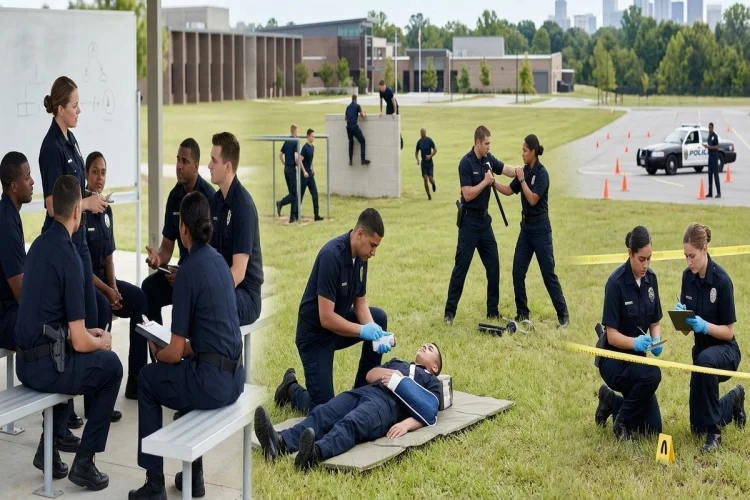
A police cadet programme is about much more than learning how to wear a uniform, march correctly, or pass a fitness test.
Students are preparing for a profession where a single decision can affect someone’s safety, freedom, or trust in law enforcement. So, what students learn inside a police cadet programme usually covers a surprisingly wide range of subjects.
Depending on the country and agency, training may include criminal law, communication, report writing, investigations, first aid, physical fitness, defensive tactics, driving, ethics, community policing, and realistic scenario exercises.
The exact structure varies between jurisdictions.
For example, California’s Regular Basic Course currently covers 43 learning domains and requires at least 680 hours of POST-developed training and testing, while the LAPD academy combines academic instruction with driving, firearms, physical training, and tactics.
For students thinking about a policing career, understanding this training gives a much clearer picture of what preparation for real police work actually involves.
1. Learning Criminal Law and Police Powers
One of the biggest parts of police training happens in the classroom.
Cadets need to understand the laws they will eventually enforce. Depending on the jurisdiction, this may include criminal law, constitutional or human-rights principles, arrest procedures, search and seizure rules, evidence, traffic law, and criminal procedure.
California POST, for example, includes learning domains covering the criminal justice system, criminal law, property crimes, crimes against persons, search and seizure, arrest methods, evidence, and other legal topics.
The goal is not simply to memorise legal definitions.
Students must learn how to apply legal rules to situations that are rarely as simple as textbook examples. If an officer wants to detain someone, enter a property, search a vehicle, or make an arrest, there needs to be a lawful reason.
A useful training question becomes: “What authority allows me to take this action?”
Developing that habit early helps future officers make more defensible decisions in the field.
2. Writing Reports and Conducting Basic Investigations
Police work involves a lot more writing than many new students expect.
Officers need to document incidents clearly because their reports may later be read by supervisors, detectives, prosecutors, defence lawyers, judges, insurance investigators, and other professionals.
LAPD academy academics include report writing, preliminary investigation techniques, arrest and booking procedures, traffic investigation, and communications.
Cadets therefore practise turning observations into accurate written records.
Imagine arriving at a burglary. A student may need to record when the incident was reported, what the victim said, what damage was visible, where evidence was located, and what witnesses observed.
Good reporting separates facts from assumptions.
Instead of writing, “The suspect was obviously planning another theft,” an officer should document the specific behaviour that led to that conclusion.
This attention to detail becomes essential when an incident later reaches court.
3. Physical Fitness Is About Doing the Job Safely
Police officers may spend long periods sitting in vehicles or writing reports, but they also need to be ready for sudden physical demands.
A routine shift can quickly involve running, climbing stairs, carrying equipment, helping an injured person, controlling a resisting suspect, or working for hours during an emergency.
That is why police cadet training usually includes physical conditioning.
NYPD recruit training, for instance, incorporates calisthenics and defensive tactics alongside other physical and safety skills. LAPD training similarly includes physical fitness, defensive tactics, and preparation for the physical demands of police work.
Fitness training is not simply about becoming stronger.
Students also learn discipline, endurance, coordination, stress management, and the ability to perform tasks while tired.
Those abilities matter because real emergencies do not wait until an officer feels rested and comfortable.
4. Communication and De-Escalation Are Core Police Skills
One of the most underrated police tools is conversation.
Officers regularly meet people who are angry, frightened, confused, intoxicated, grieving, or experiencing severe emotional distress. Knowing how to communicate can sometimes prevent a difficult encounter from becoming dangerous.
Modern police academies increasingly incorporate these skills into recruit preparation. The NYPD states that academy training focuses on areas including communication, de-escalation, community policing, and safe tactics.
Cadets may practise giving clear instructions, listening actively, gathering information, managing conflict, and explaining police decisions.
Why De-Escalation Matters
Suppose two people are involved in a heated argument outside a restaurant.
Immediately shouting commands may not always be the best opening strategy. An officer may first need to create distance, identify who is involved, listen to each person, recognise potential threats, and decide whether the situation can be calmed.
Good communication does not replace enforcement when enforcement is necessary.
It gives officers more options.
5. Cadets Practise Safety and Defensive Tactics
Police training must also prepare students for situations where communication alone does not solve the problem.
Cadets can receive instruction in officer safety, searches, handcuffing, defensive tactics, tactical movement, and lawful use-of-force concepts. The exact techniques and equipment vary substantially between departments.
NYPD recruit training includes defensive tactics, frisking, cuffing, first aid, CPR, and other safety skills.
However, modern training increasingly tries to put these techniques into realistic context.
The College of Policing in England and Wales introduced updated public and personal safety training built around scenarios officers are likely to encounter during everyday duties.
This matters because knowing a technique in a gym is different from deciding whether it is appropriate during a confusing real-world encounter.
Students have to learn both how to act and when an action is justified.
6. Emergency Driving and First Aid Can Be Just as Important
Police officers frequently arrive at emergencies before other specialised services.
That means seemingly unrelated skills such as driving and first aid can become critical parts of police education.
LAPD academy driving instruction includes an Emergency Vehicle Operations Course covering defensive driving, pursuit policy, and safe vehicle handling.
Driving quickly is not the real objective. Reaching an incident safely while controlling risk is.
First aid has similar importance.
The College of Policing updated its first-aid learning programme so officers receive at least 12 hours of initial first-aid training, followed by annual refresher training.
Cadets may encounter CPR, bleeding control, emergency assessment, or other lifesaving skills depending on their programme.
An officer may be sent to a crime but arrive to discover that saving a life is the immediate priority.
7. Ethics and Community Policing Shape Professional Behaviour
Police students are not trained only to ask, “Can I do this?”
They also need to think about whether their decisions are fair, professional, proportionate, and consistent with their responsibilities to the public.
California POST places leadership, professionalism and ethics at the beginning of its Regular Basic Course learning domains and separately includes principled policing in the community.
That placement reflects an important reality.
Officers are given significant authority. Communities therefore expect them to use that authority responsibly.
Community policing lessons can introduce cadets to problem-solving, public trust, neighbourhood engagement, cultural awareness, and partnerships with residents or local organisations.
Instead of seeing every community problem as something solved by arrest, students learn that prevention and cooperation may sometimes produce better results.
A recurring vandalism problem, for example, might require enforcement-but also better lighting, conversations with businesses, youth engagement, or changes to the physical environment.
8. Scenario Training Connects Everything Together
Eventually, classroom knowledge has to survive contact with reality.
That is why scenario-based exercises are such an important part of modern police training.
Students might encounter a simulated traffic stop, domestic dispute, suspicious person, medical emergency, burglary investigation, or confrontation requiring de-escalation.
The exercise forces them to combine multiple skills at once.
They must communicate clearly, identify legal issues, observe their surroundings, manage safety, choose appropriate tactics, and explain their decisions afterward.
This kind of training exposes mistakes in a controlled environment.
A cadet might know the correct legal rule on an exam but forget to communicate clearly under pressure. Another may be physically confident but overlook an important witness or fail to document an incident properly.
Scenario training helps turn separate lessons into practical decision-making. The College of Policing’s scenario-based safety approach similarly uses realistic situations to develop officers’ ability to apply skills to everyday encounters.
That transition from knowing to doing is one of the most important parts of police education.
Understanding what students learn inside a police cadet programme shows just how broad police preparation can be.
Cadets may study law and investigations in one lesson, practise communication or report writing in another, and then move into fitness, emergency driving, first aid, defensive tactics, or realistic simulations.
The overall goal is not simply to produce someone who can enforce laws. Good training aims to develop officers who can think clearly, communicate professionally, make lawful decisions, manage risk, and serve communities responsibly.
If you are considering a police career, start preparing beyond the fitness test. Build your writing, communication, legal reasoning, teamwork, and decision-making skills too.
Those abilities may ultimately be just as important as physical strength when academy training turns into real police work.