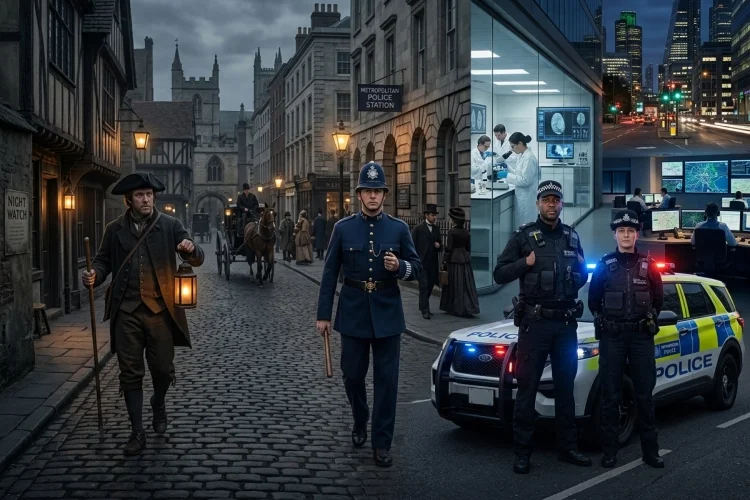
Police officers, patrol cars, forensic laboratories, emergency dispatch centres, and specialised investigation units feel like normal parts of modern society. Go back a few centuries, however, and law enforcement looked completely different.
Understanding how modern police services developed through history shows that today’s policing systems were not created all at once.
They evolved as cities grew, governments became more organised, technology improved, and societies changed their expectations about crime prevention, public order, accountability, and individual rights.
Early communities often depended heavily on local watchmen, constables, sheriffs, citizens, and other authorities to keep order. Over time, these loose systems gradually developed into permanent professional organisations.
One major turning point came with the creation of London’s Metropolitan Police in 1829, while other countries developed their own models based on local political and social conditions.
From walking beats to fingerprints and digital databases, the history of policing is really a story of continuous adaptation.
1. Policing Existed Long Before Modern Police Departments
People needed ways to maintain order long before professional police departments appeared.
Earlier systems were usually much more local and less specialised. Communities relied on constables, watchmen, sheriffs, military authorities, courts, and sometimes ordinary citizens to respond to wrongdoing.
The basic goals would sound familiar today: protect property, catch offenders, maintain public order, and enforce the decisions of authorities.
The big difference was organisation. There was often no large, permanent police institution with standardised recruitment, training, uniforms, equipment, or procedures.
The United States provides a good example of how different law enforcement institutions developed separately. The U.S. Marshals were created under the Judiciary Act of 1789, making the Marshals Service the country’s oldest federal law enforcement agency.
This reminds us that policing did not follow one global timeline. Different countries built law enforcement systems around their own legal structures and social needs.
2. The Metropolitan Police Changed the Policing Model
One of the most important milestones in the history of modern policing occurred in London in 1829.
That year, Sir Robert Peel established the Metropolitan Police. According to the Metropolitan Police’s historical timeline, the new organisation began under two commissioners and was geographically divided into 17 divisions.
The importance of the Met was not simply that London suddenly had police officers. It helped demonstrate a model of permanent, organised civilian policing designed for a rapidly growing urban environment.
London’s police service also became increasingly specialised. The Met established a Detective Branch in 1842, later replaced by the Criminal Investigation Department in 1878.
These developments reflected a broader change in thinking.
Policing was gradually becoming a defined occupation rather than an occasional responsibility shared among watchmen, citizens, local officials, and other authorities.
3. Industrial Cities Created New Policing Challenges
The nineteenth century brought enormous changes to cities.
Industrialisation and urban growth meant more people were living, working, travelling, and doing business in increasingly crowded environments.
Police organisations had to deal with theft, violence, public disorder, traffic, political demonstrations, and other challenges on a much larger scale.
In the United States, municipal policing expanded during the nineteenth century.
A major National Institute of Justice study describes an American “political era” of policing beginning around the 1840s, when police departments often had very close relationships with local political organisations.
That system brought problems of its own.
Political influence could shape recruitment, priorities, and enforcement. As policing organisations grew, reformers increasingly argued that departments needed professional standards, stronger management, better training, and greater independence from political interests.
The result was another major stage in police development: professionalisation.
4. Police Work Became a Professional Career
During the late nineteenth and early twentieth centuries, reformers pushed policing toward a more professional model.
Instead of viewing officers simply as local representatives of political authorities, reformers wanted departments to become disciplined organisations built around training, merit, management, and specialised knowledge.
The Influence of Police Professionalism
August Vollmer, police chief of Berkeley, California, from 1905 to 1932, became an important figure in American police professionalisation.
Research archived by the U.S. Office of Justice Programs credits Vollmer with introducing or promoting innovations including mobile patrols, beat analysis, scientific detection methods, better crime records, improved personnel standards, and other managerial reforms.
These ideas sound ordinary today, which shows how deeply professionalisation changed policing.
Police departments increasingly developed ranks, training systems, centralised records, specialist detective units, recruitment requirements, and standard operating procedures.
The officer was gradually becoming a trained professional working within a structured organisation.
5. Technology Transformed Police Investigations
Technology has changed policing almost continuously.
An early example is fingerprint identification. London’s Metropolitan Police created its Fingerprint Bureau in 1901.
In the United States, fingerprint systems expanded during the early twentieth century, and the FBI has collected and exchanged fingerprint records on a national scale since 1924.
Communication technology changed patrol work too.
Police once depended heavily on face-to-face communication, whistles, call boxes, and written messages. London’s Metropolitan Police, for example, introduced police boxes beginning in 1928 before personal radios eventually replaced them in the 1960s.
Later came patrol cars, radio dispatch, computers, digital records, DNA analysis, surveillance systems, body-worn cameras, automated fingerprint searches, and sophisticated crime analysis.
Modern investigators can now work with digital evidence from phones, computers, online accounts, financial systems, and security cameras.
The tools changed dramatically, but technology also created a permanent challenge: police agencies must balance investigative capability with privacy, law, security, and accountability.
6. Police Reform Changed How Success Was Measured
Professional policing solved some problems, but it created new questions.
By the middle of the twentieth century, many police organisations emphasised centralised management, rapid emergency response, patrol cars, and professional separation from political influence.
Yet researchers and practitioners increasingly questioned whether professional distance had also separated officers too much from the communities they served.
A widely cited National Institute of Justice framework describes American policing as moving from a political era into a reform era and later toward an emerging community problem-solving era.
The reform model became especially influential from the 1930s through the 1960s before facing growing challenges during the 1970s.
At the same time, civil-rights debates placed greater attention on police conduct, discrimination, constitutional protections, and accountability.
Those concerns did not disappear. The U.S. Department of Justice’s later pattern-or-practice reform work has addressed issues involving constitutional policing, organisational reform, public safety, and police-community trust.
Modern police development therefore involves more than becoming better at catching offenders. It also includes stronger expectations around legality, fairness, ethics, transparency, and oversight.
7. Community Policing Added Partnership and Problem-Solving
By the late twentieth century, another major idea was gaining influence: police should work more closely with communities rather than operate as an organisation separated from them.
Community policing emphasises partnerships and problem-solving.
Instead of responding repeatedly to the same incident, officers may work with residents, businesses, schools, local governments, and social services to understand why a problem keeps occurring.
In the United States, community policing received major institutional support when the Office of Community Oriented Policing Services, commonly known as the COPS Office, was created through the 1994 Violent Crime Control and Law Enforcement Act.
The shift did not eliminate traditional police functions.
Officers still patrol, respond to emergencies, investigate crime, make lawful arrests, and protect people. Community policing simply expanded the idea of what successful police work could involve.
Preventing a recurring neighbourhood problem can be just as important as responding quickly after the next incident happens.
8. Modern Policing Continues to Evolve
Today’s police services would be almost unrecognisable to an officer from the nineteenth century.
Modern departments may include cybercrime specialists, forensic investigators, intelligence analysts, negotiators, public-order teams, traffic units, victim-support personnel, digital evidence specialists, and officers trained to respond to mental health crises.
Police organisations have also become more diverse. London’s Metropolitan Police timeline, for example, records the gradual integration of women into wider policing roles during the twentieth century, including the abolition of its separate female branch in 1972.
Expectations continue to change as well.
Modern communities increasingly expect police to combine effective law enforcement with professionalism, transparency, accountability, technological competence, communication skills, and respect for individual rights.
That means the history of police services is not finished.
New forms of cybercrime, artificial intelligence, digital evidence, changing social expectations, and emerging security threats will continue shaping what police organisations look like in the future.
Learning how modern police services developed through history shows that policing has always changed alongside society.
Early local watch systems gradually gave way to organised departments, professional training, specialist investigators, scientific evidence, rapid communication, advanced technology, and community-based strategies.
Important milestones such as the creation of the Metropolitan Police in 1829, the professionalisation movement, fingerprint identification, and the rise of community policing helped shape the services we recognise today.
Yet modern policing remains a work in progress. Technology, public expectations, crime patterns, and ideas about accountability continue to evolve.
If you are studying policing or criminal justice, do more than memorise important dates. Look at why each reform happened. Understanding that connection makes it much easier to see where policing may go next.