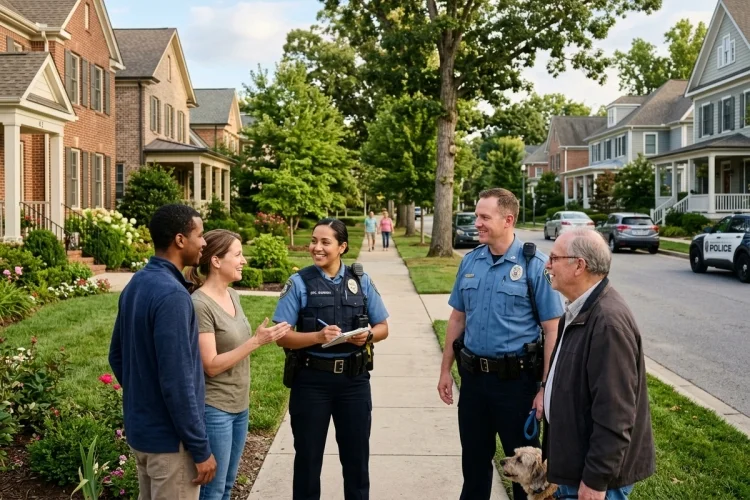
A safer neighbourhood is not created simply by putting more police cars on the streets.
Long-term public safety often depends on something less visible: communication, trust, cooperation, and a good understanding of the problems residents actually experience.
That is the basic idea behind community policing for safer neighbourhoods. Instead of treating police officers and residents as two separate groups, community policing encourages them to work together.
Officers learn more about the people and places they serve, while residents get more opportunities to raise concerns, share information, and participate in solving local problems.
The U.S. Department of Justice’s Office of Community Oriented Policing Services describes community policing around three central components: community partnerships, problem-solving, and organisational transformation.
This approach does not replace emergency response or criminal investigation. Instead, it adds a preventive strategy that asks an important question: How can police and communities solve problems before they become bigger ones?
1. What Does Community Policing Actually Mean?
Community policing is a philosophy rather than a single programme.
At its core, it encourages police departments to develop lasting relationships with residents, businesses, schools, local organisations, and other community groups.
Those relationships help law enforcement understand local concerns instead of relying entirely on emergency calls and crime reports.
Traditional reactive policing often begins after something has happened. Someone reports a burglary, officers respond, evidence is collected, and an investigation begins.
Community-oriented policing still includes those duties, but it also asks why certain problems keep happening.
For example, if the same park repeatedly attracts vandalism and antisocial behaviour at night, officers might work with residents, local authorities, youth organisations, and property managers to understand the underlying causes.
The solution could involve policing, but it might also involve better lighting, youth activities, environmental changes, or improved communication between neighbours.
2. Community Partnerships Create Better Local Intelligence
Residents know things about their neighbourhoods that police officers may never discover during routine patrols.
They know which abandoned buildings attract trouble, where dangerous driving regularly occurs, when vandalism usually happens, and which public areas people have started avoiding.
Community engagement gives officers access to this local knowledge.
The College of Policing recommends ongoing two-way communication between police and the public. Engagement should help officers identify local priorities while also giving communities feedback about what police are doing in response.
That communication can happen through neighbourhood meetings, school visits, door-to-door conversations, community events, online platforms, or informal conversations during patrol.
The key word is two-way.
Community policing is not simply police officers telling residents what to do. Residents need opportunities to explain their concerns too.
When that communication works, police gain a clearer picture of what is actually happening on the ground.
3. Trust Makes Crime Prevention Easier
Trust may sound like a soft concept compared with arrests or patrols, but it has practical value in policing.
Officers depend heavily on information from the public. Witnesses report suspicious activity, victims describe offenders, shop owners provide security footage, and residents may identify patterns that help investigators connect separate incidents.
People may be more willing to cooperate when they believe police will listen and treat them fairly.
Research on procedural justice and police legitimacy has repeatedly examined connections between fair treatment, legitimacy, and public cooperation.
An Office of Justice Programs systematic review found evidence supporting the value of procedural-justice-based dialogue in police interactions.
Importantly, positive contact does not always need to involve enforcement.
A field experiment published through the Office of Justice Programs found that positive non-enforcement contact between officers and residents improved public attitudes toward police.
A conversation at a community event may therefore seem small, but repeated positive interactions can contribute to stronger police-community relationships.
4. Problem-Solving Goes Beyond Making Arrests
One of the most useful parts of community policing is its focus on recurring problems.
Consider a neighbourhood where residents regularly complain about motorcycles speeding through a particular street. Police could issue tickets whenever officers happen to catch someone speeding.
That might help temporarily, but a problem-solving approach goes further.
Officers and community partners might examine when speeding is most common, whether road design encourages excessive speed, whether nearby schools create additional risks, and whether targeted enforcement or engineering changes would provide a better long-term solution.
The College of Policing says neighbourhood problem-solving should help police and partner organisations address long-term community issues while reducing repeated demand on services.
This illustrates an important difference between reactive and preventive policing.
An arrest, citation, or warning addresses an immediate incident. Problem-oriented community policing tries to reduce the chances that the same incident will happen again.
5. Visible Officers Can Help When Patrol Is Targeted
Police visibility can also play an important role in safer neighbourhoods, but simply having officers walk around without a clear purpose is not automatically enough.
Effective neighbourhood policing combines presence with engagement and problem-solving.
Evidence reviewed by the College of Policing indicates that targeted foot patrol, when combined with community engagement and problem-solving, can reduce crime and antisocial behaviour while providing reassurance to residents.
This combination matters.
An officer who regularly works in the same area may begin recognising business owners, young people, community leaders, and recurring neighbourhood concerns. Residents also become familiar with the officer rather than meeting police only during emergencies.
Imagine two approaches to the same shopping district.
In one, officers appear only after a robbery or fight. In another, officers regularly speak with shop owners, learn where problems occur, discuss prevention strategies, and remain accessible when concerns emerge.
The second approach creates more opportunities for prevention.
6. Residents Also Have a Role in Community Safety
Community policing does not mean shifting police responsibilities onto ordinary citizens.
Residents are not expected to investigate crimes or physically confront offenders. Their role is mainly about communication, participation, awareness, and cooperation.
For example, neighbours can report recurring problems, attend local safety meetings, provide information about incidents, improve security around homes and businesses, and participate in community programmes.
Local organisations can contribute too.
Schools may help address youth problems. Housing organisations can improve unsafe environments. Mental health professionals may assist people in crisis. Transport departments can help with dangerous roads.
That is why modern neighbourhood policing increasingly involves partnerships rather than assuming every public-safety problem has a purely police solution.
College of Policing guidance specifically emphasises working with communities and partners to address long-term local issues.
A safer neighbourhood is usually the result of many people solving different parts of the same problem.
7. Community Policing Must Include Fairness and Accountability
Community relationships can disappear quickly if residents believe officers are unfair, disrespectful, or unwilling to explain their decisions.
That makes procedural justice important.
People may not always agree with a police decision. Someone might receive a traffic ticket, be asked to leave an area, or see police take an enforcement action they dislike.
However, officers can still communicate respectfully, listen when appropriate, explain their actions, and make decisions without improper bias.
Research on police legitimacy suggests that perceptions of fairness matter for public willingness to cooperate with police.
Accountability matters as well.
If residents repeatedly raise a problem but never hear what happened, community meetings can start feeling meaningless. Police agencies therefore need mechanisms for communicating progress, explaining limitations, and acknowledging when a different strategy is required.
Effective community policing is not simply about being friendly.
It requires reliable communication and visible follow-through.
8. How Community Policing Can Make Neighbourhoods Safer
The biggest strength of community policing is that it combines several public-safety strategies rather than relying on one.
Police visibility can discourage certain problems. Resident information can improve local awareness. Problem-solving can target recurring causes. Partnerships can bring in services that police cannot provide, while fair interactions can make continued cooperation more likely.
Research reviewed by the College of Policing found that police-public collaboration for problem-solving can reduce perceived disorder while improving trust and perceptions of police legitimacy.
This does not mean community policing automatically eliminates crime.
Some neighbourhoods face serious violence, organised crime, drug markets, poverty, housing problems, or other challenges that require specialised responses and broader government action.
Community policing is most useful when viewed as part of a wider public-safety strategy.
Its central idea remains powerful: police can understand and address local problems more effectively when the people living with those problems are part of the conversation.
Understanding what community policing means for safer neighbourhoods starts with recognising that public safety is a shared process.
Police officers still investigate crimes and respond to emergencies, but community-oriented policing adds communication, prevention, partnerships, and long-term problem-solving.
Strong relationships can help officers understand local concerns earlier, while residents gain a clearer way to communicate the problems affecting everyday life.
When engagement is combined with targeted policing, procedural fairness, and practical solutions, neighbourhood safety becomes more than simply responding to the next emergency.
If you want to support community safety, start locally.
Learn how neighbourhood policing works in your area, report recurring concerns, participate in community discussions, and help turn police-community contact into an ongoing partnership rather than something that happens only during a crisis.