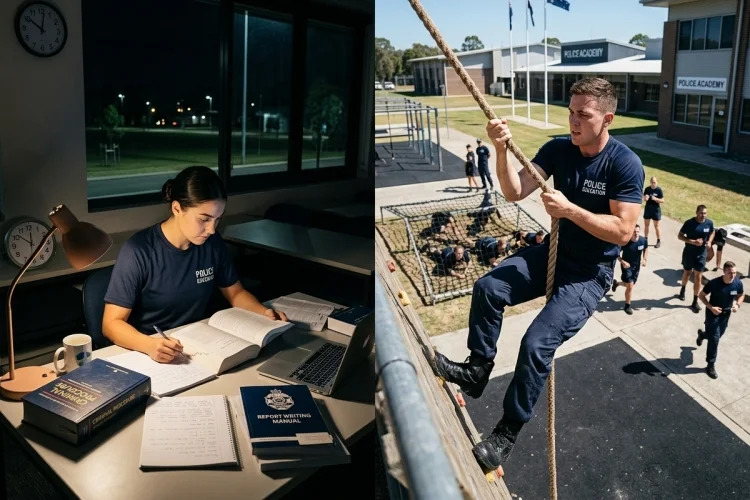
Police education can be demanding in ways that surprise new students.
One day may involve criminal law and report writing, while the next includes physical conditioning, practical scenarios, defensive tactics, or assessments that require students to perform under pressure.
Talent helps, but talent alone rarely carries someone through that kind of environment. What often makes the difference is the ability to keep studying, training, preparing, and following standards even when motivation drops.
That is where self-discipline in police education becomes important. Research outside policing has also linked self-discipline with academic performance.
A well-known longitudinal study by Angela Duckworth and Martin Seligman found that self-discipline predicted several academic outcomes among adolescents and accounted for more variance in final grades than IQ in their sample.
Police students face their own combination of academic, physical, ethical, and emotional demands. Developing disciplined habits can therefore help them become more consistent learners-and eventually more reliable professionals.
1. Self-Discipline Creates Consistent Study Habits
It is easy to study when an exam is tomorrow. The harder skill is studying when there is no immediate pressure.
Police education often involves large amounts of information. Students may need to understand criminal law, search procedures, investigation methods, report writing, communication, human relations, tactics, and many other subjects.
LAPD academy training, for example, combines classroom academics with areas such as law, report writing, investigations, driving, firearms, physical fitness, and tactics.
Trying to learn everything through last-minute cramming is risky.
A disciplined student creates a repeatable routine. They might review lecture notes every evening, practise legal scenarios several times a week, and revise older topics before they begin forgetting them.
Small Sessions Beat Occasional Marathons
Studying for 30 or 45 focused minutes regularly can often be more manageable than waiting for one giant weekend study session.
For example, a police student learning arrest procedures could divide the subject into definitions, legal requirements, practical examples, and scenario questions. Working through one section at a time reduces the feeling that everything has to be mastered at once.
Self-discipline turns preparation into a routine rather than an emergency.
2. Discipline Helps Students Maintain Physical Readiness
Physical preparation is another area where consistency matters.
Police academy fitness requirements can be demanding. The LAPD tells applicants that its academy physical training programme is intense and recommends beginning physical conditioning before academy entry rather than waiting until training begins.
You cannot realistically build endurance, strength, mobility, and recovery habits overnight.
A disciplined approach means exercising regularly while also paying attention to sleep, nutrition, hydration, and recovery. It also means knowing when reckless overtraining could create an injury that interrupts progress.
Think of two students.
One trains extremely hard for five days and then stops for two weeks. The other follows a realistic programme several times each week for months.
The second approach may look less dramatic, but consistency is usually much more useful when preparing for long-term physical demands.
Self-discipline is not about punishing your body. It is about preparing it intelligently.
3. Time Management Keeps Multiple Responsibilities Under Control
Police students rarely have only one responsibility.
They may need to attend classes, prepare assignments, exercise, practise skills, complete reading, study for examinations, and still manage ordinary responsibilities outside training.
Without organisation, small unfinished tasks can quickly pile up.
Self-discipline helps students decide what deserves attention before a deadline becomes urgent. A simple weekly schedule can divide time between academic review, physical training, sleep, practical preparation, and personal commitments.
One useful strategy is to identify the next specific action.
“Study criminal law” is vague. “Review search-and-seizure notes from 7:00 to 7:45 p.m.” is much easier to follow.
The goal is not to organise every minute of your life. It is to reduce unnecessary decisions.
When studying and training already have a regular place in your schedule, you spend less time negotiating with yourself about whether you feel like doing them.
4. Self-Control Matters When Training Becomes Stressful
Police education is designed partly to prepare students for work that can involve uncertainty and pressure.
That means students may sometimes have to make decisions while tired, nervous, distracted, or being evaluated.
Stress can influence performance. Research supported by the National Institute of Justice has specifically examined training approaches intended to improve police decision-making and stress management during difficult situations.
Self-discipline helps students practise controlling their response to pressure.
Imagine making a mistake during a scenario exercise. One student becomes frustrated, stops listening to feedback, and spends the rest of the day thinking about the failure.
Another recognises the mistake, listens carefully, identifies what went wrong, and prepares to perform better next time.
The second reaction does not require ignoring emotions.
It requires managing them well enough to continue learning.
That ability becomes especially valuable in policing, where officers may eventually need to remain professional even when other people are angry, insulting, frightened, or unpredictable.
5. Discipline Makes Feedback Easier to Use
Nobody enjoys being told they performed poorly.
Police training, however, involves correction. Instructors may identify problems with a student’s report writing, communication, physical technique, tactical decisions, legal knowledge, or judgment.
Self-discipline helps separate feedback from ego.
Instead of thinking, “The instructor does not like me,” a productive student asks, “What exactly needs to improve?”
Suppose an instructor returns a police report covered with corrections. The disciplined response is not simply rewriting the assignment once. It is looking for patterns.
Maybe the student regularly mixes facts with assumptions. Perhaps timelines are unclear, grammar makes statements difficult to understand, or important observations are missing.
Finding that pattern turns criticism into a training tool.
This mindset also supports professional development because policing involves continued learning rather than education ending on graduation day.
6. Self-Discipline Supports Ethical Decision-Making
Discipline is not only about studying and exercise.
It also involves controlling impulses when taking an easier shortcut would be tempting.
Police officers operate under significant ethical responsibilities. The International Association of Chiefs of Police states that professional ethics and integrity affect areas ranging from recruitment and training to assignments and field activities.
Its Policing Code of Ethics was updated in 2024 to reflect contemporary policing responsibilities.
Students begin building those professional habits during education.
Consider a simple academic example. A student who copies an assignment because they did not prepare may think the decision has nothing to do with future police work.
But the underlying habit matters.
Professional integrity requires accurately documenting events, following rules, handling information responsibly, and resisting shortcuts that may be convenient but improper.
Self-discipline teaches students to choose the correct process even when the easier option is available.
That is one reason everyday academic behaviour can help shape professional character.
7. Good Discipline Includes Rest and Recovery
There is an important misunderstanding about discipline: it does not mean working constantly.
A student who sleeps four hours a night, trains excessively, skips meals, and studies without breaks may appear dedicated. In reality, that routine can eventually reduce concentration and performance.
Law-enforcement research has long recognised fatigue as a serious issue. The National Institute of Justice notes that excessive stress and fatigue can impair officer decision-making and create problems for both officer and public safety.
Future police students should therefore treat recovery as part of preparation.
Going to bed at a reasonable time can require discipline. Taking a planned recovery day rather than adding another unnecessary workout can require discipline too.
The same principle applies to study breaks.
Self-discipline should create sustainable performance, not exhaustion.
Students who build balanced routines are preparing for a career where managing personal readiness can matter as much as completing individual tasks.
8. Discipline Turns Motivation Into Long-Term Progress
Motivation is useful, but it changes constantly.
A student may feel highly motivated after receiving an academy acceptance letter. Three months later, after difficult exams, early mornings, sore muscles, and repeated corrections, that excitement may feel very different.
Self-discipline provides stability when motivation becomes unreliable.
The practical secret is to make important behaviours routine.
Prepare your uniform and equipment the night before. Study at a regular time. Keep training sessions scheduled. Review mistakes after practical exercises. Arrive early enough that small delays do not become emergencies.
None of these habits is particularly exciting.
Together, however, they reduce chaos.
Research on academic self-discipline also supports the broader idea that consistent self-regulation can be closely related to educational performance.
In Duckworth and Seligman’s study, students with stronger self-discipline showed better outcomes across grades, attendance, homework behaviour, and other measures.
Success often comes from ordinary behaviours repeated long enough to produce extraordinary improvement.
Understanding how self-discipline supports success in police education means recognising that discipline affects almost every part of training.
It helps students study consistently, maintain physical readiness, manage time, respond to stress, learn from criticism, make ethical choices, and take recovery seriously.
Police education is unlikely to feel easy every day, and motivation will naturally rise and fall. Strong routines provide something more dependable.
If you are preparing for police education, start developing discipline before training begins. Create a realistic study schedule, exercise consistently, protect your sleep, practise accepting feedback, and finish small responsibilities when you said you would.
You do not need to transform yourself overnight. Build one reliable habit, then another. Those everyday choices can become the foundation for both academic success and professional responsibility.