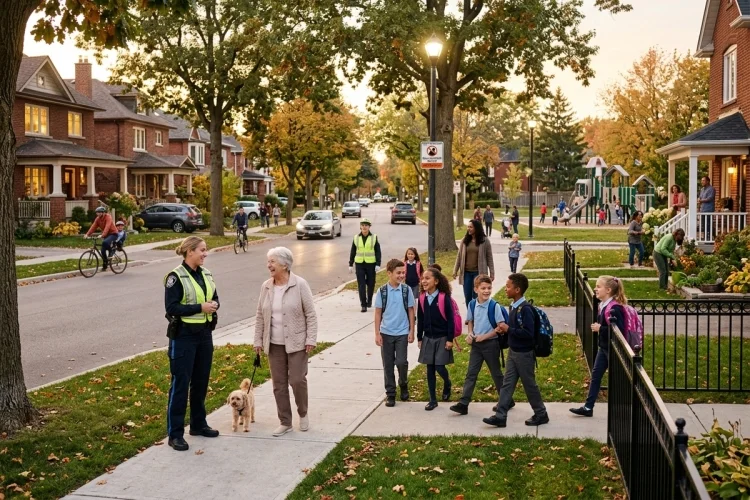
The best crime is often the one that never happens. When a burglary, assault, fraud, or act of vandalism is prevented, there is no victim who has to recover, no property to replace, and no investigation needed after the damage is done.
That simple idea sits at the heart of how crime prevention reduces harm before it happens.
Crime prevention focuses on identifying risks, reducing opportunities for offending, strengthening protective factors, and solving recurring problems before they develop into more serious incidents.
The United Nations Office on Drugs and Crime defines crime prevention broadly as strategies and measures designed to reduce both the risk of crimes occurring and their potential harmful effects on individuals and society.
This approach can involve police, but it does not belong to law enforcement alone. Schools, families, businesses, urban planners, social services, health professionals, and local residents can all play a part.
Effective prevention is therefore less about predicting exactly who will commit a crime and more about creating conditions where crime becomes less likely.
1. Crime Prevention Starts Before an Offence Occurs
Traditional criminal justice responses usually begin after an incident.
Someone reports a burglary, police investigate, evidence is gathered, and the justice system may eventually deal with the offender. These responses remain important, but they cannot undo all the harm caused by the original crime.
Crime prevention takes a different starting point.
Instead of asking only, “Who committed this crime?” prevention also asks, “Why is this problem happening, and what could reduce the chance of it happening again?”
The National Institute of Justice researches a wide variety of prevention strategies covering traditional offences as well as emerging problems such as identity theft and human trafficking.
Imagine a car park experiencing repeated thefts.
Police can investigate each case individually. A prevention strategy might also examine lighting, surveillance, access points, security procedures, and the times when theft occurs most often.
Solving those weaknesses may prevent future victims from experiencing the same problem.
2. Reducing Opportunities Can Make Crime More Difficult
Some crimes happen partly because an opportunity is available.
An unlocked bicycle left in an isolated area, poor lighting around a business, valuables clearly visible inside a parked car, or weak access control in a building can make offending easier.
Situational crime prevention focuses on changing those immediate conditions.
The National Institute of Justice notes that situational approaches examine how opportunities and circumstances can influence criminal behaviour. Research in this area has explored strategies that make offending more difficult, risky, or less rewarding.
For example, a shop experiencing repeated theft might change product placement, improve staff observation, or restrict easy access to high-risk items.
These measures do not require knowing exactly who the next offender will be.
They change the environment instead.
This is a practical insight for everyday safety: crime prevention frequently works by removing easy opportunities rather than trying to eliminate every possible motivation for crime.
3. Better Environmental Design Can Support Safer Places
The physical environment can influence how safe a location feels and how easily people can observe what is happening.
This is where ideas such as Crime Prevention Through Environmental Design, often shortened to CPTED, become relevant.
Simple changes may include improving lighting, keeping entrances visible, maintaining landscaping so it does not create hidden areas, controlling access to restricted spaces, or designing public areas where legitimate users provide natural observation.
CrimeSolutions, part of the U.S. Office of Justice Programs, includes environmental strategies such as improved street lighting within the wider field of situational crime prevention.
Consider two pedestrian paths.
One is dark, hidden behind overgrown vegetation, and rarely used. The other has good lighting, clear visibility, nearby activity, and entrances that can easily be monitored.
Good design does not guarantee that crime will disappear, but it can reduce opportunities and make suspicious behaviour easier to notice.
That makes urban design part of public safety rather than merely an aesthetic issue.
4. Problem-Solving Helps Stop Repeat Incidents
Many police calls are not completely unrelated events.
The same location, behaviour, or underlying condition may generate repeated problems.
Community policing addresses this by combining partnerships with systematic problem-solving.
The U.S. Department of Justice’s COPS Office describes community policing as using partnerships and problem-solving techniques to proactively address conditions connected with crime, disorder, and fear of crime.
Imagine residents repeatedly reporting fights outside the same entertainment venue every weekend.
Simply sending officers each time may restore order temporarily. A problem-solving approach would examine why the incidents keep happening.
Perhaps closing times create large crowds at once. Maybe lighting is poor, transport options are limited, alcohol management needs improvement, or security arrangements are inadequate.
Police, business owners, transport officials, and local authorities can then address those specific conditions.
Crime prevention becomes more effective when it focuses on the pattern rather than treating every event as completely separate.
5. Early Intervention Can Reduce Future Risk
Not every prevention strategy focuses on places.
Some focus on people and the conditions surrounding them.
Violence, for example, rarely develops from one simple cause. The CDC explains that risk and protective factors can exist across individual, relationship, community, and societal levels.
Protective factors can include supportive relationships, positive school environments, strong community connections, opportunities for young people, and skills for solving problems without violence.
This is why prevention programmes may involve schools, families, mentoring, mental health services, recreation programmes, or employment support rather than police alone.
The CDC’s youth violence prevention guidance emphasises supporting young people at home, at school, in their communities, and as they prepare for their futures.
Early intervention is not about labelling someone as a future criminal.
It is about reducing known risks and strengthening conditions that make healthy, safe behaviour more likely.
6. Community Partnerships Provide Better Solutions
Police officers see many public-safety problems, but they do not see everything.
Residents know which streets feel unsafe. Shop owners notice patterns of theft. Teachers may see emerging conflicts between students. Housing managers understand recurring problems in particular buildings.
Combining these perspectives can produce better prevention strategies.
UNODC crime-prevention guidance emphasises cooperation and coordinated approaches because effective prevention often involves several sectors rather than a single criminal justice agency.
Community policing follows a similar principle.
The COPS Office describes partnerships as a central part of proactive problem-solving.
Suppose a neighbourhood experiences repeated vandalism around an unused public space.
Police might provide incident data, residents can explain when problems happen, local authorities can improve lighting or maintenance, and community organisations might develop activities that bring legitimate users back into the area.
No single participant has the entire solution.
Crime prevention works best when information and responsibility are shared.
7. Prevention Should Be Based on Evidence, Not Guesswork
Not every idea that sounds tough or sensible actually prevents crime.
That is why evidence matters.
Crime prevention strategies should be evaluated to see whether they reduce offending, simply move it somewhere else, create unintended consequences, or produce no meaningful change.
The National Institute of Justice studies and evaluates prevention programmes precisely because different approaches can produce different results.
Research on deterrence provides a useful example. NIJ notes that the certainty of being caught generally has a stronger deterrent effect than simply increasing the severity of punishment.
That finding challenges the assumption that harsher penalties are automatically the best prevention strategy.
Good prevention therefore involves a cycle: identify the problem, understand its causes, choose an evidence-informed response, measure the result, and adjust when necessary.
The objective is not to look tough.
It is to reduce actual harm.
8. Prevention Reduces More Than Crime Numbers
Crime produces costs that are difficult to capture in statistics.
Victims may experience injury, financial loss, trauma, fear, disrupted education, lost work, damaged relationships, or long-term feelings of insecurity.
Communities can also suffer.
Businesses may leave areas perceived as unsafe. Residents may stop using parks or public transport. Families may avoid certain streets. Trust between neighbours can decline.
Preventing an offence therefore protects more than one potential victim.
It can preserve people’s confidence in the places where they live, study, work, and spend time.
This explains why the UN crime-prevention framework considers not only the frequency of crime but also its harmful effects on individuals and society.
Success should therefore not be measured only by arrest totals.
Sometimes the strongest public-safety outcome is fewer emergencies, fewer victims, and fewer people needing the criminal justice system in the first place.
Understanding how crime prevention reduces harm before it happens changes the way we think about public safety.
Effective prevention does not wait for every crime to occur before taking action. It identifies recurring problems, reduces opportunities, improves environments, strengthens protective factors, and brings communities together to address risks early.
Police remain important, but prevention is much broader than policing. Families, schools, businesses, health services, local authorities, and residents all have useful roles.
The practical starting point is simple: look for patterns rather than isolated incidents.
If the same problem keeps occurring in your neighbourhood, school, workplace, or business, ask what conditions are allowing it to continue. Addressing those conditions today may prevent someone from becoming a victim tomorrow.