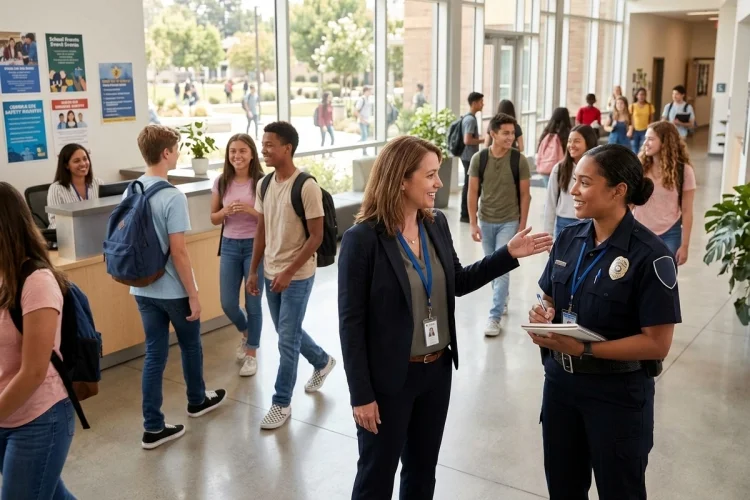
A safe school is not simply a building with locked doors, cameras, or security officers.
Students also need to feel comfortable asking for help, teachers need clear emergency procedures, and families need confidence that serious concerns will be handled appropriately.
This is where cooperation between education professionals and law enforcement can make a difference. Understanding how schools and police build safer learning environments means looking beyond emergency response.
Effective partnerships may include emergency planning, violence prevention, traffic safety, threat assessment, community engagement, and relationship-building with students.
SchoolSafety.gov brings together federal resources covering emergency preparedness, violence prevention, cybersecurity, mental health, and other parts of school safety, highlighting how broad the issue really is.
However, police presence alone does not automatically create a better learning environment. Clear responsibilities, appropriate training, fairness, student wellbeing, and cooperation with educators are equally important.
The strongest school safety strategies treat security as a shared responsibility rather than a job for one person or agency.
1. Schools and Police Need Clearly Defined Roles
A successful partnership starts with understanding who is responsible for what.
Teachers and administrators are primarily responsible for education and ordinary school discipline. Police officers, meanwhile, focus on public safety, criminal matters, emergency response, and other law-enforcement responsibilities defined by local law and agreements.
This distinction is important because everyday student behaviour should not automatically become a police matter.
The U.S. Department of Justice describes school resource officers, or SROs, as career law enforcement officers assigned to educational settings in a community-policing capacity. Federal guidance also stresses collaboration between officers, schools, and community organisations.
Written agreements can make those expectations clearer.
For example, a memorandum of understanding can explain when school staff should contact an officer, who handles normal disciplinary issues, how information is shared, and what responsibilities an officer has during emergencies.
Current COPS Office guidance specifically supports clearly defined agreements for SRO programmes.
Clear boundaries reduce confusion and help students experience a more predictable environment.
2. Emergency Planning Works Better Before a Crisis
The middle of an emergency is a terrible time to decide who should do what.
Schools and police can prepare together by developing and practising emergency plans covering situations such as fires, severe weather, dangerous intruders, medical emergencies, or other major incidents.
SchoolSafety.gov identifies emergency operations planning as a core part of school preparedness and encourages collaborative planning involving school personnel, law enforcement, emergency responders, and other community partners.
The benefit is coordination.
Imagine a school evacuation. Police may need to control access roads while teachers account for students, administrators communicate with families, and medical services prepare to assist anyone who is injured.
If these groups have never discussed the plan, valuable time can be lost.
Regular exercises can identify simple problems before a real emergency happens. Perhaps a meeting point is too close to traffic, emergency responders cannot easily access a gate, or staff members do not know who has authority to make certain decisions.
Finding those weaknesses during a drill is much safer than discovering them during a crisis.
3. Building Trust Helps Students Share Concerns
Students often notice problems before adults do.
They may hear about bullying, threats, fights, weapons, online harassment, or a classmate who appears to be struggling seriously. Whether students share that information can depend partly on whether they trust the adults around them.
Police officers working in schools can contribute to that trust when their role includes positive, non-enforcement interaction.
COPS Office material describes school-based officers as working collaboratively with schools and engaging in community-oriented policing rather than simply waiting for criminal incidents.
Simple interactions matter.
An officer who attends a student event, answers questions about road safety, or speaks casually with students during lunch becomes more familiar than an officer students see only after something has gone wrong.
That familiarity may make approaching an adult feel less intimidating.
However, trust must also be earned through respectful treatment, consistency, confidentiality within legal limits, and fair decision-making.
A school safety partnership works best when students see officers as accessible professionals rather than simply symbols of punishment.
4. Threat Assessment Focuses on Prevention
One important development in modern school safety is behavioural threat assessment.
The basic idea is to identify concerning behaviour, gather information, assess the seriousness of the situation, and determine what support or intervention may reduce the risk of harm.
The U.S. Secret Service National Threat Assessment Center has produced guidance specifically for schools and law enforcement on developing threat assessment processes.
Its model focuses on identifying students of concern and assessing whether circumstances indicate a risk of violence or other harmful behaviour.
This is different from assuming that every unusual comment means a student is dangerous.
A proper assessment looks at context.
For example, a concerning message might lead a multidisciplinary team to gather information from teachers, administrators, counsellors, family members, and law enforcement when appropriate.
The goal is prevention rather than prediction.
Sometimes the appropriate response may involve police investigation. In other cases, counselling, family support, conflict resolution, academic assistance, or mental health services may address the underlying concern more effectively.
That is why threat assessment works best as a team process rather than an exclusively police function.
5. Police Can Support Safety Beyond Serious Crime
School safety also includes many ordinary problems.
Traffic congestion during pickup time, unsafe pedestrian behaviour, dangerous driving around school zones, online safety concerns, and community events can all benefit from police-school coordination.
An officer might help the school review traffic patterns, teach students basic road safety, or coordinate routes during a major event.
Police can also provide practical education on topics such as internet fraud, personal safety, substance-related risks, or what students should do when they encounter an emergency.
These activities support a community-policing model.
The goal is not simply to respond when laws are broken but to reduce risk through education and early problem-solving.
For example, if drivers repeatedly speed past a school entrance, enforcement may be one part of the solution. Police and school officials might also examine crossing arrangements, signs, arrival schedules, road design, and communication with parents.
Solving the underlying problem usually requires more than issuing tickets.
6. School Discipline Should Not Automatically Become Policing
This is one of the most important boundaries in a school-police partnership.
Students sometimes break rules without committing serious crimes. They may talk back to teachers, ignore classroom instructions, arrive late, or violate ordinary school policies.
These issues generally require educational and disciplinary responses rather than automatic law-enforcement involvement.
A 2024 U.S. Government Accountability Office review found that schools where police were involved in student discipline were more likely to report student arrests than schools where police were present but were not involved in discipline.
For the 2019-2020 school year, GAO estimated that 31% of schools where police participated in discipline reported arrests, compared with 20% where police did not participate in discipline.
The report describes an association rather than proving that police involvement caused the difference.
That distinction deserves attention.
Police should be available when genuine safety threats or criminal incidents require their authority, but involving officers in routine classroom management can blur professional roles.
Strong partnerships establish boundaries before problems happen.
This protects students while also allowing police to focus on situations where law-enforcement skills are genuinely needed.
7. Training Matters for Officers Working With Students
Working in a school is different from patrolling a nightlife district or responding to ordinary street crime.
Children and teenagers are still developing socially, emotionally, and cognitively. Officers working closely with students therefore benefit from specialised preparation.
The COPS Office currently requires specified school resource officers funded through its programmes to complete school-specific training, reflecting the idea that school-based policing requires skills beyond general police training.
Training can cover youth behaviour, communication, de-escalation, school law, emergency management, disability awareness, and collaboration with educators.
Understanding adolescence is particularly useful.
A teenager who responds emotionally or challenges authority may require a different communication approach from an adult involved in a serious criminal incident.
Good training gives officers more tools.
It can help them recognise when enforcement is necessary, when a situation can be de-escalated, and when another professional-such as a counsellor, psychologist, or administrator—is better positioned to respond.
8. Safe Learning Environments Need More Than Security
Perhaps the biggest lesson is that school safety cannot be reduced to police presence.
Students also need supportive teachers, accessible mental health services, effective anti-bullying programmes, emergency plans, responsible families, safe facilities, and a positive school climate.
The federal SchoolSafety.gov framework reflects this broad approach by bringing together resources on topics ranging from emergency planning and violence prevention to student wellbeing and online safety.
Law enforcement is one partner within that larger system.
The best collaboration happens when police bring expertise in safety and emergency response while educators maintain responsibility for teaching and school culture, and health or social-service professionals address needs that fall within their expertise.
No single professional can solve every school problem.
A safer learning environment develops when each partner understands both what they can contribute and where their role should stop.
Understanding how schools and police build safer learning environments means looking beyond guards, cameras, and emergency response.
Effective cooperation can include clear roles, shared emergency planning, positive relationships with students, threat assessment, community education, traffic safety, and early problem-solving.
At the same time, good partnerships recognise important boundaries. Routine school discipline should not automatically become a police matter, and student wellbeing requires support from educators, families, counsellors, and other professionals.
Schools and law enforcement can start by reviewing their current partnership together. Are responsibilities clearly written? Do emergency plans actually work? Do students know where to report concerns?
Regularly asking these questions can turn school safety from a reactive response into an ongoing culture of preparation, trust, and prevention.