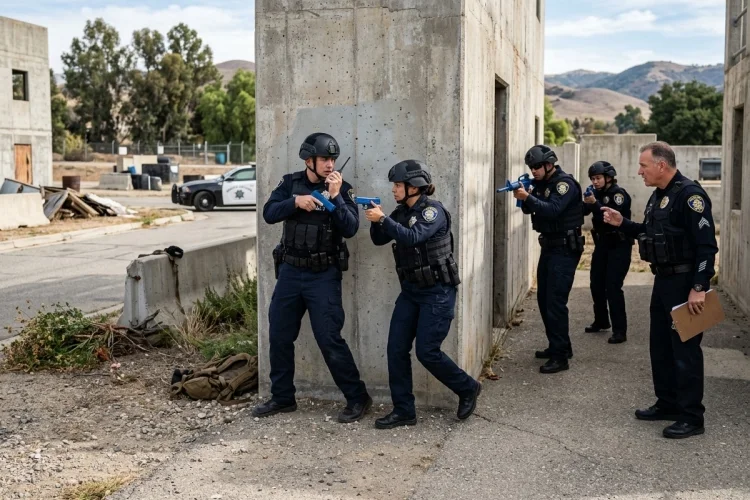
Police work is rarely a solo activity. Even when an officer appears to be working alone, they are usually connected to dispatchers, supervisors, investigators, emergency services, partner agencies, and other officers who may become involved within minutes.
That is why learning how teamwork supports effective police and cadet training is an important part of preparing for a law enforcement career. Cadets need more than individual fitness, legal knowledge, and technical ability.
They must learn how to communicate clearly, share information, trust teammates, accept different responsibilities, and make coordinated decisions when situations become stressful.
Modern police training reflects this broad preparation. California’s POST-certified Regular Basic Course, for example, requires at least 680 hours of training across 43 learning domains, showing how many different competencies recruits must eventually combine during real police work.
Teamwork helps connect those individual skills. In training, students discover that being a strong officer is not only about personal performance-it is also about helping the whole team perform safely and effectively.
1. Teamwork Builds Clearer Communication
Good teamwork starts with communication.
Police officers frequently need to exchange information quickly and accurately. During an incident, one officer may be speaking with a witness while another checks the surrounding area and someone else communicates with dispatch.
If important details are misunderstood or never shared, the entire response can become less effective.
That is why cadet exercises often benefit from requiring students to communicate while simultaneously completing other tasks. They learn to provide concise information, listen carefully, confirm instructions, and avoid unnecessary confusion.
Communication is also central to managing conflict. College of Policing guidance highlights dialogue and communication as important elements of specialist areas such as crisis negotiation, public-order policing, and firearms operations.
For cadets, the practical lesson is simple: speaking clearly is useful, but listening is equally important.
A teammate who understands the situation correctly is much more valuable than someone who simply talks the most.
2. Training Together Builds Trust
Police teams sometimes operate in uncertain or potentially dangerous environments. Officers therefore need confidence that colleagues will perform their assigned roles responsibly.
That type of trust cannot be created instantly.
Training gives cadets a safer environment in which to develop it. Students work together during physical exercises, classroom projects, practical scenarios, and problem-solving activities.
Over time, they learn who communicates well, who stays calm, and how different personalities respond to pressure.
Trust does not mean blindly following another person.
Professional teamwork also means being willing to question something when it appears unsafe, unlawful, or unclear. A dependable teammate is someone who supports colleagues while still maintaining professional standards.
The FBI National Academy similarly emphasises professional development alongside communication, leadership, and collaboration among law enforcement professionals from different agencies and jurisdictions.
Cadets can begin developing the same mindset early: earn trust through reliability rather than simply expecting others to provide it.
3. Team Exercises Improve Decision-Making Under Pressure
A classroom question often gives students time to think.
Real police situations may not.
A confusing traffic collision, missing-person search, violent disturbance, or large public event may require several people to process different pieces of information at the same time.
Scenario training helps reproduce some of that complexity.
One cadet may take the lead while another gathers information. Someone else may need to watch the environment, communicate with a simulated dispatcher, or assist a person involved in the scenario.
The College of Policing has increasingly emphasised scenario-based safety training, with realistic exercises designed to develop communication and practical decision-making.
Its review of officer and staff safety training also noted positive findings around approaches involving interpersonal communication, emotional control, rapport, and scenario-based role play or simulation.
These exercises teach an important lesson: effective teamwork does not mean everyone performs the same task.
It means different actions contribute to one shared objective.
4. Teamwork Helps Cadets Understand Roles and Responsibilities
Strong teams usually work because everyone understands their role.
Imagine a simulated emergency where five cadets all try to give instructions simultaneously. Even if everyone has good intentions, the result can quickly become confusing.
Training teaches students when to lead, when to support, and when to pass information to someone better positioned to make a particular decision.
Leadership Is Not Always About Rank
Cadet teamwork also introduces an important idea about leadership.
Leadership is not simply giving orders. It includes keeping people focused, communicating objectives, noticing problems, accepting responsibility, and using the strengths of other team members.
FBI research on leadership during crisis response found that exposure to crisis situations through training and experience contributed to leaders feeling better prepared for actual incidents.
Cadets can practise these habits by rotating responsibilities during exercises. One student may lead one scenario and support another student during the next.
Learning both positions produces a more flexible teammate.
5. Peer Learning Can Strengthen Police Education
Not everything students learn comes directly from instructors.
Cadets also learn from each other.
One student may be strong at report writing but struggle with physical conditioning. Another may perform well during practical exercises but need help understanding a legal concept.
Productive training environments allow students to share techniques and learn together without turning every activity into unhealthy competition.
This does not mean standards should be lowered.
Instead, teamwork can help more students reach those standards.
For example, cadets reviewing a scenario together can compare how each person interpreted the situation. One may notice a legal issue another overlooked, while someone else may identify a communication mistake.
Police trainers also use coaching, mentoring, feedback, communication, and management of group learning as part of professional training practice. College of Policing standards for trainers specifically identify these skills as important elements of police learning environments.
A good teammate therefore does more than perform well personally. They help others improve too.
6. Teamwork Develops Better Interpersonal Skills
Police officers work with people constantly.
They deal with colleagues, victims, witnesses, suspects, emergency personnel, social workers, community leaders, and many others. The ability to cooperate with different personalities is therefore essential.
FBI Law Enforcement Bulletin guidance on police academy education has highlighted interpersonal skills as an important part of recruit preparation, arguing that these abilities strengthen the legal and tactical skills officers already learn.
Team activities provide opportunities to practise patience, active listening, constructive disagreement, and respectful feedback.
Imagine that two cadets disagree about how a scenario should be handled.
A poor team response turns the disagreement into a personal argument. A better approach focuses on the facts: What did each person observe? What rule applies? Which option best addresses the situation?
Learning to disagree professionally is valuable because real police teams will not always see situations in exactly the same way.
The goal is not constant agreement. It is productive cooperation.
7. Team Coordination Can Improve Safety
Teamwork is also closely connected with safety.
During demanding operations, officers must maintain awareness not only of what they are doing but also of what teammates are doing.
Poor coordination can create unnecessary risks.
For example, two officers approaching an uncertain situation should ideally understand their responsibilities and communicate changes as circumstances develop. If one person suddenly changes position without communicating, the other may make decisions based on outdated information.
Training allows cadets to practise coordination before the consequences become real.
California POST’s basic academy combines numerous areas of instruction into a physically and mentally challenging programme, while its field training programmes later help newly assigned officers transition from academy education to actual patrol duties and agency procedures.
That progression highlights why teamwork cannot simply be learned from a textbook.
It must be practised repeatedly.
8. Good Teams Learn From Mistakes Together
Training is supposed to reveal weaknesses.
A scenario that goes badly can sometimes teach more than an exercise where everything works perfectly.
After an exercise, cadets may discuss what happened, identify missed information, review communication problems, and consider alternative decisions. This process is far more useful when students can talk openly without immediately becoming defensive.
Team learning also encourages accountability.
Instead of asking, “Whose fault was it?” a productive review asks, “What happened, why did it happen, and what can we do differently next time?”
That mindset prepares students for continuous professional development.
Even experienced officers continue learning. The FBI provides advanced law enforcement education covering leadership, administrative, investigative, and management skills, reflecting the reality that professional development continues throughout a policing career.
Cadet training is simply where that learning culture begins.
Understanding how teamwork supports effective police and cadet training reveals that cooperation is much more than simply getting along with classmates.
Teamwork develops communication, trust, leadership, decision-making, interpersonal skills, safety awareness, and the ability to learn from mistakes.
Police officers routinely depend on other people, especially when situations become complex or stressful. Cadet training provides an opportunity to build those habits before entering operational policing.
If you are preparing for police education, practise becoming the kind of teammate others can rely on. Listen carefully, communicate clearly, complete your responsibilities, accept constructive feedback, and help classmates improve without ignoring your own development.
Individual ability matters in policing, but reliable teams turn individual skills into coordinated professional performance.